
 1 year warranty

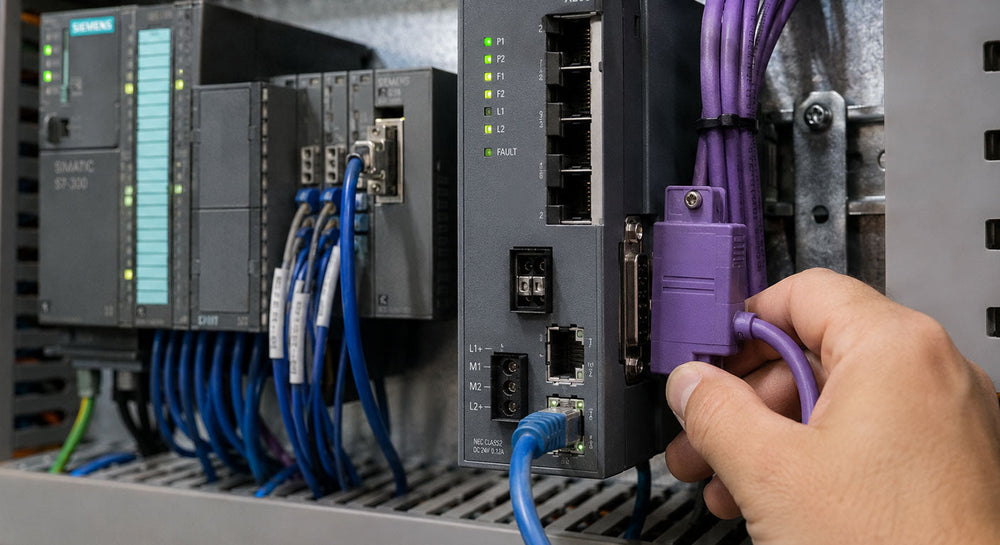
A single failed industrial network switch on a plant floor can take an entire communication segment offline, cutting PLCs off from HMIs, drives, and I/O devices they're supposed to be communicating with. On systems that have been running for a decade or more, that switch, along with the PROFIBUS cable and PROFIBUS connector hardware tying it all together, is often long discontinued by the original manufacturer.
As facilities modernize their communication infrastructure, the people managing legacy PROFIBUS and Industrial Ethernet networks are increasingly on their own to source hardware for systems the manufacturer has moved on from. This is the same challenge we covered in our post on surplus PLC parts for mines with obsolete equipment, where sourcing hard-to-find components for aging systems is often the only practical path forward without a full system redesign.
Why Do Industrial Networks on Legacy Systems Fail?
Industrial networking hardware typically fails due to connector corrosion, cable insulation failure, or aging internal switch components, especially in environments with vibration, temperature swings, or exposure to moisture. On older PROFIBUS and PROFINET installations, a single bad segment can disrupt communication across an entire section of a control system.
Common failure points on legacy industrial networks include:
-
Industrial network switch ports failing after years of continuous data traffic.
-
PROFIBUS cable insulation cracking in high-vibration or high-heat locations.
-
PROFIBUS connector pins loosening or corroding at termination points.
-
EtherNet/IP media converters reaching end of life alongside discontinued PLCs.
-
Bus terminators degrading and causing intermittent communication errors.
Because these networks connect PLCs, HMIs, drives, and I/O across an entire system, a failure in one segment can affect equipment that has nothing directly wrong with it.
What Should You Know Before Ordering a Replacement Industrial Network Switch?
Compatibility of an industrial network switch depends on the protocols it must support, the number of ports required, and whether it must match a specific manufacturer's diagnostic or addressing scheme. A generic commercial switch will often move data, but won't necessarily support the deterministic timing or diagnostics that PROFIBUS and PROFINET networks depend on.
Before ordering a replacement switch, it helps to confirm:
-
Whether the network is PROFIBUS, PROFINET, or EtherNet/IP-based
-
The number of ports and the physical mounting format required
-
Whether managed switch features like diagnostics are used elsewhere on the network
-
The voltage and DIN rail mounting requirements of the existing installation
Matching these details before ordering prevents installing a switch that physically connects but doesn't behave correctly on a protocol-sensitive network.
How Do You Identify the Right PROFIBUS Cable and Connector for an Existing Installation?
PROFIBUS cable is purpose-built with specific impedance and shielding characteristics, so substituting a generic industrial cable can introduce communication errors even when it appears to fit. The correct PROFIBUS cable for a given installation depends on whether the run is fixed, flexible, or trailing, as each type has different jacket and conductor specifications suited to its use.
The PROFIBUS connector at each end matters just as much as the cable itself. Bus connectors must match the device's mounting orientation, and many include integrated termination switches that must be set correctly for the segment's position on the network. Using the wrong connector type or leaving termination switches misconfigured is a common source of intermittent faults on otherwise healthy cable runs.
Where Do Facilities Source Discontinued Networking Hardware?
Facilities running older PROFIBUS, PROFINET, or EtherNet/IP infrastructure typically look beyond standard manufacturer channels once a switch, cable assembly, or connector series is phased out. For teams that don't want to redesign the entire communication architecture just to replace a failed switch or cable run, an independent supplier carrying surplus and used networking hardware is often the more practical route.
Siemens supports PROFIBUS communication and Industrial Ethernet networking as part of its broader automation portfolio, while Schneider Electric also carries industrial networking hardware alongside its PLC and drive platforms. Facilities managing mixed-brand networks often need to source networking hardware across these families rather than relying on a single manufacturer.
What Hardware Conditions Are Available for Industrial Networking Components?
Industrial network switches, cable, and connectors sourced through PLC Direct are classified under three condition grades: Sealed Surplus, Never Used Surplus, and Used/Refurbished. The right grade for a given order depends largely on how critical that segment is to the rest of the network staying online.
Sealed Surplus stock arrives factory-sealed, even though the batch itself may date back several production cycles. Never Used Surplus hardware has never been put into service but isn't guaranteed to carry its original factory seal. Used/Refurbished components are tested and restored to working order before they ship.
PLC Direct backs every networking component with a standard 1-year PLC Direct warranty covering defects and functionality, applicable to Sealed Surplus, Never Used Surplus, and Used/Refurbished products. This warranty is issued by PLC Direct, an independent supplier, and is not an OEM or manufacturer warranty.
A dead switch port or a cracked run of PROFIBUS cable shouldn't force a rebuild of an entire network segment. For help tracking down a compatible industrial network switch or the right PROFIBUS connector for your setup, get in touch with PLC Direct with your part number to check availability and get a quote.
