
 1 year warranty

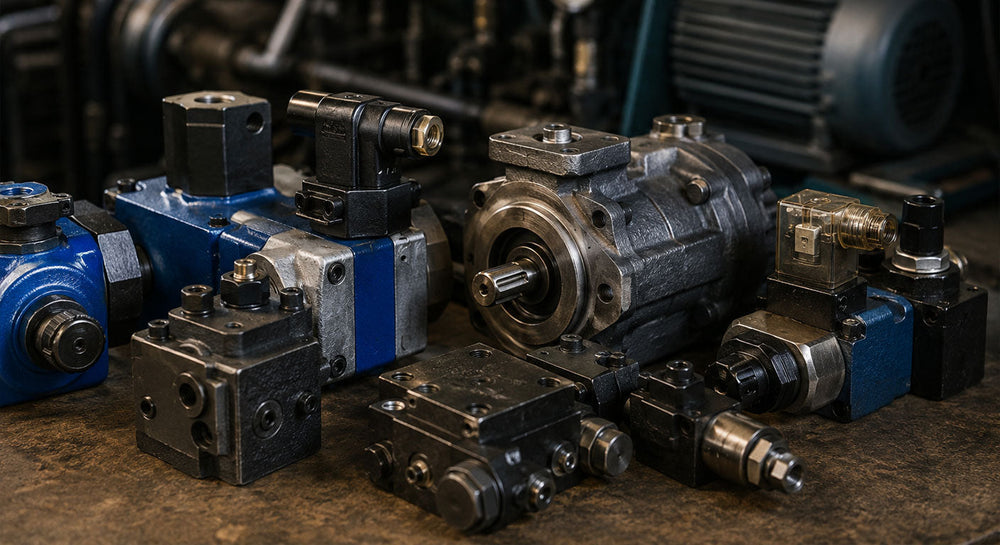
A failed hydraulic control valve on a press, injection molding machine, or mobile equipment platform doesn't just stop one component. It can shut down an entire hydraulic circuit because pumps, actuators, and proportional hardware are designed to work together as a single system. On installations that have been running for fifteen or twenty years, finding a compatible replacement often means going well beyond the original manufacturer's current catalog.
Facilities dealing with this kind of legacy sourcing challenge across their broader automation systems aren't limited to hydraulics. The same reasoning has kept many mining operations running refurbished PLCs well past their original service life instead of replacing entire systems, and it applies just as directly to hydraulic circuits: a facility running an aging hydraulic system usually needs a specific valve or pump that matches what's already installed.
Why Do Hydraulic Control Valves and Pumps Fail on Legacy Systems?
Seal wear, spool sticking from contaminated fluid, and solenoid coil burnout account for most hydraulic component failures on legacy systems. These issues rarely happen in isolation. A worn seal often leads to leakage, which in turn accelerates wear on whatever sits downstream.
Common failure points on legacy hydraulic systems include:
-
Contaminated fluid causing valve spools to stick rather than shift cleanly.
-
Solenoid coils burning out well before the rest of the valve body wears out.
-
Pump seals degrading gradually, often first showing as a small pressure loss before becoming a full leak.
-
Proportional valve electronics drifting out of calibration even when the mechanical parts are still sound.
-
Cylinder seals wearing unevenly under sustained high-pressure loads.
Because hydraulic circuits are interconnected, a failed valve or pump rarely stays isolated. Pressure and flow problems at one point in the circuit tend to surface as performance issues everywhere downstream.
What Should You Know Before Ordering a Replacement Hydraulic Control Valve?
Compatibility for a hydraulic control valve comes down to three factors:
-
The valve's flow rating
-
The circuit's pressure rating
-
The mounting pattern used to mate it to the manifold or block.
Getting any of these wrong typically means the valve installs but doesn't perform correctly under load, or doesn't seal against the mounting surface at all.
Before ordering a replacement valve, it helps to confirm:
-
The flow rate and maximum operating pressure the circuit requires.
-
The mounting pattern, such as ISO or NFPA standard porting.
-
Whether the valve is direct-acting or pilot-operated.
-
The voltage and connector type for any solenoid-actuated components.
Skipping this step is one of the most common reasons a maintenance team ends up with a valve that fits the port pattern but doesn't perform correctly once pressurized.
How Do You Identify the Right Hydraulic Solenoid Valve for an Existing Circuit?
A hydraulic solenoid valve is identified by its spool configuration, coil voltage, and connector style, all of which need to match the original circuit exactly for correct operation. Two solenoid valves that look nearly identical externally can have different spool center configurations, which change how the actuator behaves when the valve shifts.
Confirming the coil voltage is just as important as matching the spool type. A solenoid valve rated for the wrong voltage may appear to operate but will run hot, shift slowly, or fail prematurely. Cross-referencing the nameplate data with the original circuit documentation before ordering prevents installing a valve that looks correct but doesn't behave as the original did.
What Makes Proportional Hydraulic Valves Different From Standard Directional Valves?
A proportional hydraulic valve allows variable, controlled spool positioning rather than the simple on-off shifting of a standard directional valve, enabling it to regulate flow and pressure incrementally based on an electronic input signal. This makes proportional valves well-suited for applications that require smooth, controlled motion rather than abrupt on-off responses.
Because proportional valves rely on electronic feedback and calibration, replacing one on a legacy system usually requires matching not just the mechanical spool configuration but also the control signal type, such as voltage or current input, that the original system was built around. Substituting a valve with a different signal type typically means the machine's controller can't command it correctly, even if the valve installs physically.
Where Do Facilities Source Discontinued Hydraulic Hardware?
Facilities running older hydraulic systems typically look beyond standard manufacturer channels once a valve, pump, or proportional component is phased out of production. At that point, a facility's options usually narrow down to rebuilding around new hardware or sourcing a matching component through an independent supplier that still carries the discontinued line.
PLC Direct carries hydraulic valves, pumps, and proportional hardware from manufacturers including Vickers and Rexroth, alongside other brands used in industrial and mobile equipment applications. Facilities managing older or mixed-brand hydraulic systems often need to source across several brands to keep a single circuit fully operational, and PLC Direct can help confirm which brands and product lines are currently available for a specific application.
What Condition Grades Apply to Hydraulic Valves and Pumps?
Hydraulic components sourced through PLC Direct fall into one of three condition grades: Sealed Surplus, Never Used Surplus, and Used/Refurbished. Choosing between them usually comes down to how much risk a facility can tolerate on a component tied to continuous operation.
Sealed Surplus hardware is still factory-sealed, though the underlying stock may come from an older production run. Never Used Surplus components have never been installed but may no longer carry their original factory seal. Used/Refurbished units undergo inspection and testing and are brought back to working order before they're sold.
PLC Direct backs every hydraulic component with a standard 1-year PLC Direct warranty covering defects and functionality, applicable to Sealed Surplus, Never Used Surplus, and Used/Refurbished products. This warranty is issued by PLC Direct, an independent supplier, and is not an OEM or manufacturer warranty.
A worn spool or a burned-out solenoid coil doesn't have to mean rebuilding a hydraulic circuit from scratch. PLC Direct can check compatibility and current availability for a hydraulic control valve, hydraulic solenoid valve, or proportional hydraulic valve against your installed system. Send over your part details to check availability and get a quote.
