
 1 year warranty

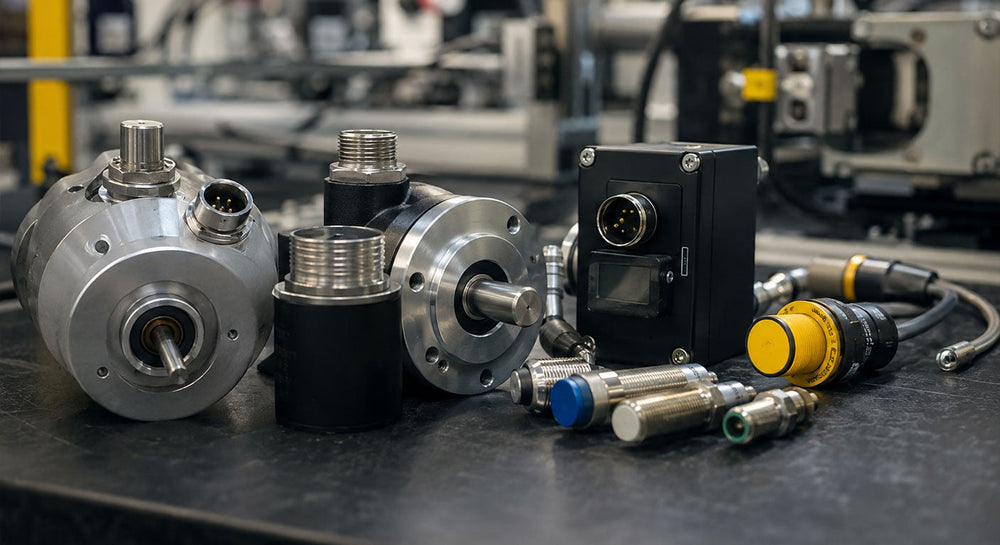
When a rotary encoder fails on a servo axis or conveyor line, the machine usually stops outright. Motion controllers depend on continuous position feedback to operate safely, so losing that signal typically causes the system to fault immediately. For maintenance teams managing older automation equipment, the harder problem is rarely diagnosing the failure. It's finding an exact-match replacement for a component the original manufacturer stopped producing years ago, the same kind of decision covered in 3 Signs to Upgrade Your Programmable Logic Controller, where a platform reaching end-of-life status makes sourcing individual replacement parts harder over time, until a fuller upgrade becomes the more practical option.
That gap between what a plant needs and what's available through standard channels is where a rotary encoder, an absolute encoder, or a position sensor becomes a procurement issue rather than a quick swap. Maintenance teams supporting legacy motion control systems need a source that understands the technical differences between encoder types and the realities of sourcing parts for equipment no longer covered by the original manufacturer.
What Is the Difference Between a Rotary Encoder and an Absolute Encoder?
A rotary encoder is the broader category: any device that converts the angular position or rotation of a shaft into an electrical signal that a control system can read. Within that category, encoders split into two types based on how they report position. An absolute encoder outputs a unique code for every distinct shaft position, so it knows exactly where the shaft is, even immediately after a power cycle. Incremental encoders report only position changes and require homing to a reference point before the system can calculate absolute position.
This distinction matters for replacement sourcing. Swapping an incremental encoder for an absolute encoder on the same axis usually requires reprogramming the motion controller's homing routine, so confirming which type is currently installed before ordering saves a second troubleshooting trip.
Where Are Rotary Encoders and Position Sensors Used in Motion Control Systems?
Rotary encoders and position sensors show up wherever a control system needs to know the location, speed, or rotational position of a moving part. Common applications include:
-
Manufacturing lines using servo-driven axes for precision part placement and assembly
-
Packaging and filling equipment synchronizing conveyor speed with fill or capping stations
-
Material handling systems tracking conveyor and lift positions
-
CNC and machine tool applications requiring high-resolution encoders for spindle and axis positioning
-
Elevator and hoist systems using absolute encoders to retain position memory through power loss
Because encoders sit directly in the motion feedback loop, a failed unit tends to stop the axis entirely rather than cause a gradual performance decline, which is why sourcing speed matters as much as technical accuracy. PLC Direct carries encoders from manufacturers such as Sick, with its DFS60 and AFM60 series, and Turck, with its contactless inductive RI360 series.
What Types of Position Sensors Work Alongside Encoders?
Position sensors offer broader detection capabilities than encoders and generally fall into four categories:
-
Inductive sensors for detecting metallic targets without contact
-
Capacitive sensors for detecting non-metallic materials or objects through container walls
-
Magnetic sensors for pneumatic cylinder piston detection
-
Photoelectric sensors for general object presence detection
Encoders and position sensors are frequently specified on the same machine, with the encoder handling continuous feedback on a rotating axis and discrete position sensors confirming presence at fixed points. PLC Direct stocks position sensing hardware from IFM and Omron, covering inductive, capacitive, and photoelectric detection types.
What Should I Check Before Ordering a Replacement Encoder or Position Sensor?
Matching a replacement encoder correctly comes down to three variables: resolution (pulses or bits per revolution), output signal type (incremental options such as line driver, open collector, or push-pull; absolute options such as SSI or fieldbus), and mechanical mounting, including shaft diameter and housing style. For position sensors, sensing range and connector type are the equivalent variables. Getting any of these wrong on an installed system usually means the replacement won't integrate with the existing wiring or controller configuration, so pulling nameplate data from the failed unit before ordering is the safest starting point.
What Condition Grade Makes Sense for an Encoder or Position Sensor?
An encoder feeding a bottleneck axis carries a different risk profile than a position sensor on a secondary material handling segment. A position sensor in a low-priority segment tolerates more risk than an encoder feeding a critical motion axis, where a failure stops the axis entirely. PLC Direct grades its encoder and position sensing hardware to reflect that: Sealed Surplus, Never Used Surplus, and Used/Refurbished.
Sealed Surplus stock stays in its original factory packaging, even if the batch itself is from an earlier production run. Never Used Surplus components have never gone into service, but the factory seal isn't guaranteed to still be intact. Used/Refurbished units go through inspection and testing before they're cleared for resale.
All three condition grades carry the same coverage: a standard 1-year PLC Direct warranty covering defects and functionality, applicable to Sealed Surplus, Never Used Surplus, and Used/Refurbished products. This warranty is issued by PLC Direct, an independent supplier, and is not an OEM or manufacturer warranty.
If a rotary or absolute encoder feeding a critical motion axis fails, PLC Direct can help maintenance teams source a compatible replacement. Contact PLC Direct with your part number to check availability and get a quote, subject to inventory.
