
 1 year warranty

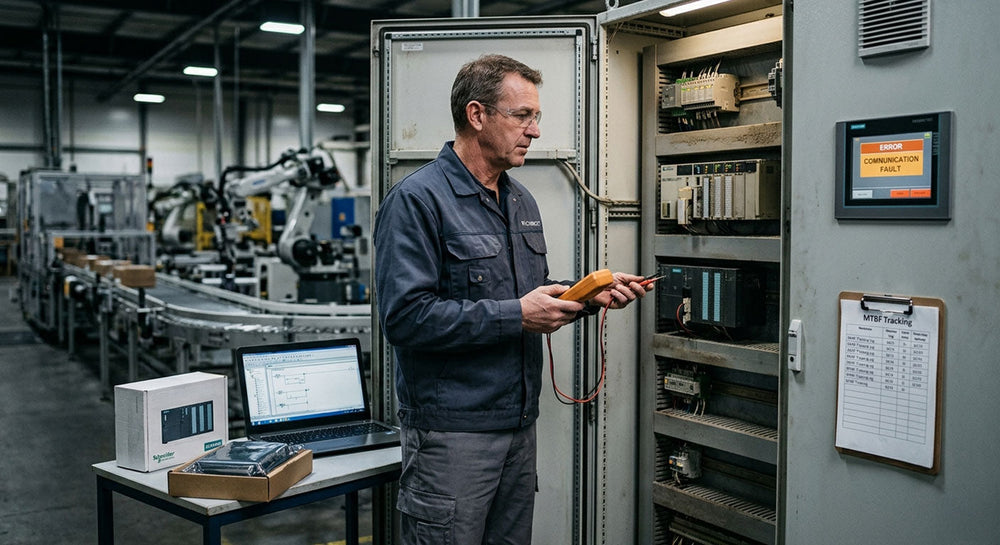
Automation equipment has a working life, and programmable logic controllers are no exception. A PLC that was correctly specified for a facility five or ten years ago may no longer match current production demands, software environments, or support realities. Knowing when to act on a programmable logic controller PLC change process is as operationally important as the upgrade itself. Delaying beyond the point at which a system is still serviceable introduces compounding risk: more frequent faults, longer diagnostic cycles, and sourcing challenges for parts that manufacturers have phased out.
Here are three signs that a PLC upgrade warrants serious evaluation.
Sign 1: You Are Experiencing More Downtime
One of the most obvious PLC upgrade signs is a rise in unplanned downtime. While every machine will experience occasional stoppages, recurring faults that follow a pattern are a diagnostic signal, not a maintenance anomaly.
Aging PLCs accumulate wear on processor boards, power supply components, and I/O modules. Battery-backed memory can fail, causing program loss on restart. Capacitors in older power supplies degrade, producing intermittent faults that are difficult to trace. When maintenance engineers find themselves repeatedly clearing the same fault codes or swapping the same modules, the underlying issue is often the platform itself rather than any individual component.
Tracking mean time between failures (MTBF) for a PLC installation provides procurement and maintenance teams with data to make a case for replacement. When downtime frequency crosses the threshold at which it measurably affects throughput, the cost of replacement becomes straightforward to justify relative to the cost of lost production.
Sign 2: Your PLC Is No Longer Supported by the Manufacturer
Manufacturer support for PLC platforms follows a predictable lifecycle: active production, limited availability, and eventually end-of-life. When a platform reaches end-of-life status, firmware updates stop, technical support is discontinued, and OEM spare parts become increasingly difficult to source through standard channels.
A PLC that is no longer supported by the manufacturer cannot receive software patches that address known bugs or security vulnerabilities in networked environments. It also cannot be extended with newer communication modules or I/O expansions that require current firmware versions. For facilities running SCADA-connected automation or integrating PLCs with enterprise systems, an unsupported platform becomes a liability in both operational and security terms.
This is also the point at which independent suppliers become a practical resource. Surplus sealed and refurbished hardware for legacy platforms, including Siemens SIMATIC S7-300 and S7-400, Schneider Electric Modicon Premium and Quantum, and Mitsubishi Electric MELSEC Q Series, remains available outside OEM channels. This extends the operational life of a legacy installation while a migration plan is developed, or bridges availability gaps during a phased replacement.
Sign 3: You Are Having Difficulty Making Process Changes
A critical part of the programmable logic controller PLC change process to recognize is difficulty adjusting internal production logic. As facilities grow, add product lines, or shift to new process requirements, the control system needs to keep pace. Older PLCs can be difficult to reprogram, particularly when the original development environment is no longer supported by current engineering tools or when the programming language used is no longer familiar to the maintenance team.
When to replace a PLC is often answered by this question: how long does it take to implement a process change, and what is the cost of that delay? If modifying a conveyor sequence, adjusting a batch recipe, or adding a new I/O point requires extended downtime or outside contractor support because the platform is too outdated to work with efficiently, the platform is constraining operations rather than enabling them.
Newer PLC platforms from Omron, Schneider Electric, and Siemens offer structured text and function block programming environments that align with current IEC 61131-3 standards, enabling faster process changes and reducing reliance on legacy-specific expertise.
What To Do Once You Have Identified the Signs?
Upgrading a PLC involves more than selecting a replacement processor. The evaluation should account for I/O compatibility with existing field wiring, communication protocol support for connected devices, HMI compatibility, and whether the new platform can be phased in alongside the existing installation or requires a full cutover.
For facilities managing multiple lines or sites with mixed installed bases, standardizing on a current platform reduces long-term support complexity. Sourcing refurbished or surplus sealed hardware from the same platform family can support a phased migration without the full capital outlay of a simultaneous site-wide replacement.
Wrapping Up
Evaluating whether a PLC has reached the end of its useful service life is a decision that affects production continuity, maintenance overhead, and long-term automation costs. PLC Direct stocks surplus sealed, refurbished, and used automation hardware across platforms, including Siemens SIMATIC, Schneider Electric Modicon, Omron Sysmac and CJ Series, and Mitsubishi Electric MELSEC, along with associated I/O modules, VFDs, and HMIs to support both legacy maintenance and upgrade projects. To check availability on specific part numbers or request a quote, contact us today.
