
 1 year warranty

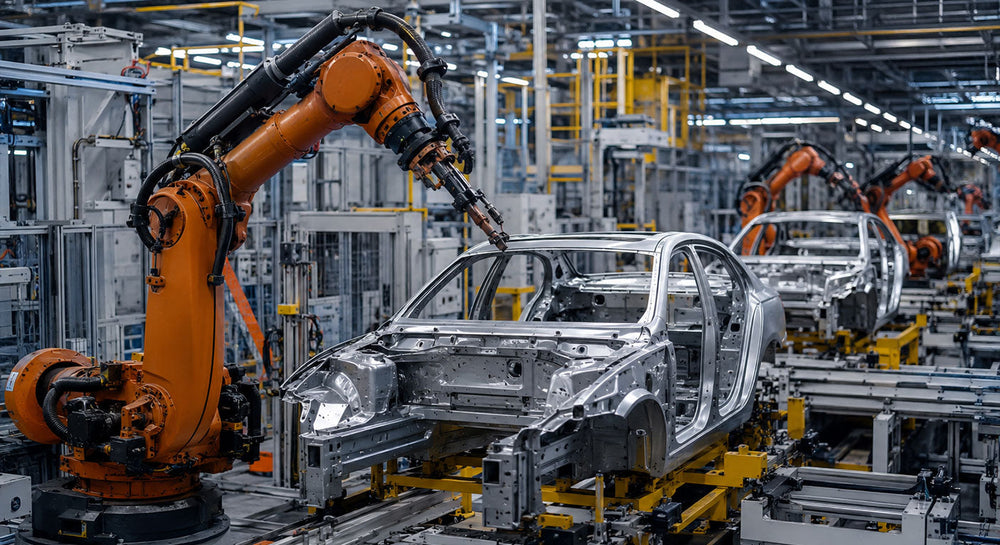
An automotive assembly line runs welding guns, conveyors, and positioning stations through the same cycle thousands of times a shift, with almost no built-in slack. A servo drive or proximity sensor that fails on a lower-volume line might cost an afternoon of downtime. The same failure on a synchronized body-in-white or paint line stops every station timed to it, often within seconds of the fault.
That synchronization is what makes automotive sourcing harder than a straight parts swap. A replacement component must closely match the original part's response speed, safety rating, and communication protocol to maintain the line's timing, not just fit the mounting pattern. Maintenance teams supporting these lines are usually managing several automation platforms across different stations, installed or upgraded at different points, which adds another layer to quickly finding the right match.
Why Does Automotive Automation Hardware Wear Out Faster Than in Other Industries?
High cycle counts are the main driver behind faster component wear on automotive lines. A robotic weld cell or conveyor station that cycles every few seconds accumulates in a single week the kind of mechanical and electrical stress that a lower-volume application might see over a year.
A few patterns recur on high-cycle automotive lines. Servo drives and motors wear out from constant acceleration and deceleration cycles rather than steady-state running. Proximity sensors and photoelectric switches fail due to repeated shocks and vibrations at the weld and stamping stations. Safety relays and light curtains degrade over time due to constant triggering as parts and operators move through work cells. I/O modules connected to high-speed conveyor and indexing systems experience connector wear well before their rated service life. PLCs and HMIs at the line-control level often outlast the mechanical components around them, but their replacement parts still become scarce as platforms age out of production.
Because these lines are synchronized across multiple stations, a failure at one point can cascade into downtime at every station timed to it.
What Should You Confirm Before Replacing an Automotive Automation Component?
Getting a replacement component running on a synchronized line takes more than matching a part number. Cycle time compatibility, safety certification, and communication protocol must all align with the rest of the cell before the replacement returns to production.
Before ordering a replacement component for an automotive assembly line, it helps to confirm:
-
The cycle time or response speed the component needs to meet
-
Any safety certification requirements for the station, such as light curtain or safety relay ratings
-
The communication protocol that synchronizes the component with the rest of the cell
-
Physical mounting and enclosure suited to the station's environment
Skipping this step is a common reason a replacement part installs correctly but still throws the line's timing or safety interlocks out of sync.
Which Automation Platforms Are Commonly Found on Automotive Lines?
A synchronized automotive line depends on several distinct hardware categories working together, and a replacement strategy needs to account for each one separately rather than treating the line as a single automation platform.
Line-control PLCs coordinate sequencing and interlocking across a station or cell, with Siemens a common brand in this role. Motion and servo hardware handles the precise, repeated positioning that welding and assembly stations depend on, with Siemens also covering that function on motion-heavy cells. HMIs give operators visibility into station status and fault conditions, a role both Mitsubishi Electric and Siemens fill depending on the station. Machine-level controllers on conveying, packaging, and material-handling segments, such as those from Omron, tend to run somewhat independently of the heavier motion-control stations elsewhere on the line.
Because these categories are sourced and replaced separately, a facility supporting an aging line is rarely managing just one automation standard. The relevant question for sourcing is which component category just failed and which platform that specific station was built around, not which single vendor the line runs on.
How Do You Identify the Right Replacement Part for a High-Cycle Production Cell?
Confirming the exact model, series, and firmware or configuration version on the existing component is the starting point for any replacement on a synchronized line. Two components from the same platform can differ in response time or I/O configuration in ways that matter significantly at high cycle rates, even when they look interchangeable.
Cross-referencing the nameplate or configuration data against the original cell documentation before ordering helps confirm the replacement will actually keep pace with the rest of the station, rather than becoming the new bottleneck once the line restarts.
Where Do Automotive Facilities Source Discontinued Line Components?
Facilities running older automotive automation lines typically look beyond standard manufacturer channels once a drive, sensor, or controller reaches the end of life. Independent suppliers specializing in surplus and used industrial hardware have become a practical option for keeping high-cycle lines running without a full cell redesign, sourcing controllers, drives, and HMIs across whichever platform a given station was built around.
PLC Direct carries automation hardware across multiple platforms used in automotive assembly lines, including controllers, drives, HMIs, and safety components designed for these high-cycle environments. Facilities managing mixed-vendor lines often need to source from multiple platforms simultaneously to keep a single station fully operational.
What Condition Grade Makes Sense for a High-Cycle Line Component?
Not every part on an automotive line carries the same downtime cost if it fails again. A sensor on a low-priority conveyor segment tolerates more risk than a controller at the line's bottleneck station, where a repeat failure halts every downstream operation. PLC Direct classifies its automation hardware into three condition grades to reflect that: Sealed Surplus, Never Used Surplus, and Used/Refurbished.
Sealed Surplus stock stays in its original factory packaging, even if the batch itself is from an earlier production run. Never Used Surplus parts have never gone into service, but the factory seal isn't guaranteed to still be intact. Used/Refurbished components go through inspection and testing before they're cleared for resale.
All three grades carry the same coverage: a standard 1-year PLC Direct warranty covering defects and functionality, applicable to Sealed Surplus, Never Used Surplus, and Used/Refurbished products. This warranty is issued by PLC Direct, an independent supplier, and is not an OEM or manufacturer warranty.
Because criticality, not price, should drive the choice, it's worth thinking through how much downtime a repeat failure at that specific station would cost before deciding which grade to choose. Talk to PLC Direct about the controllers, drives, or safety components your line needs to check availability and get a quote.
