
 1 year warranty

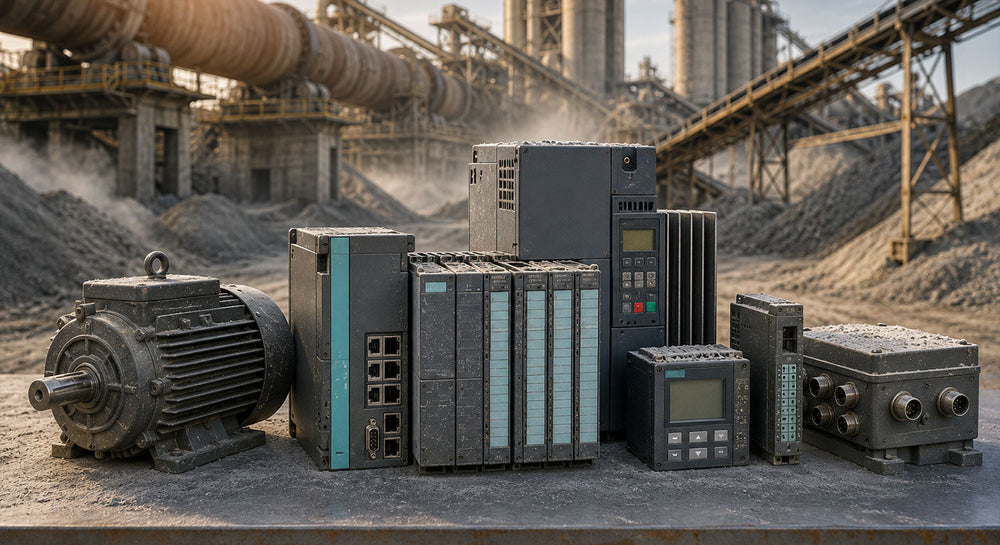
Cement production runs some of the most physically punishing conditions a piece of automation hardware will ever face. Kiln areas run hot enough to stress standard electronics well outside their rated range, raw mills and clinker handling generate constant abrasive dust, and vibration from crushers and conveyors works its way into every panel bolted nearby. Standard PLCs, drives, and instrumentation designed for a controlled indoor environment weren't built to withstand that combination for long, which is why much of the automation running a cement plant today is built around hardware rated for harsh conditions.
The real challenge for maintenance teams is finding the extreme-condition variant of a failed part, since a standard-rated component dropped into a harsh environment installation tends to fail again quickly, sometimes faster than the original unit did. The same due-diligence approach covered in 5 Important Factors To Consider When Buying a PLC applies here too: matching the environmental rating of a replacement part matters as much as matching its base electrical specification.
What Makes the Cement Manufacturing Process So Demanding on Standard Automation Hardware?
The cement manufacturing process moves raw material through crushing, grinding, blending, and high-temperature kiln processing before the finished clinker is ground into cement, and each of those stages creates its own stress on nearby electronics:
-
Kiln and clinker cooler areas expose control cabinets to sustained high ambient temperatures.
-
Raw mill and cement mill areas generate fine abrasive dust that works into connectors and cooling vents.
-
Crushing and conveyor sections introduce continuous vibration that loosens standard mounting and connections over time.
Any one of these conditions alone can shorten the service life of automation hardware not built to handle it, and most cement plants deal with several of them at once across different sections of the same facility.
What Is Harsh Environment Electronics in the Context of Cement Plant Automation?
Harsh environment electronics refers to automation hardware built or adapted specifically to operate reliably outside the temperature, humidity, and contamination limits of standard industrial equipment. In cement plant automation, this typically means components with conformal coating to resist dust and moisture ingress, extended operating temperature ranges to handle kiln-area heat, and mechanical designs built to tolerate continuous vibration without loosening connections.
Siemens SIPLUS is one recognized product line built this way, based on standard SIMATIC and SINAMICS platforms but adapted for extended temperature ranges, high humidity, condensation, and corrosive atmospheres beyond what standard-rated hardware tolerates.
Where Is Automation Hardware Used Across a Cement Plant?
Automation hardware supports nearly every stage of cement production. Common applications include:
-
Raw material crushing and grinding stations use PLCs and drives to control mill speed and load.
-
Kiln and preheater systems rely on process instrumentation to monitor temperature and material flow under continuous high-heat exposure.
-
Clinker cooling and material handling operations use motors and conveyor drives rated for dust and vibration exposure.
-
Cement grinding and blending stations use weighing and batching instrumentation to control material ratios.
-
Bagging and load-out operations use HMIs and sensors to manage packaging line throughput.
Because these stages run continuously and are physically difficult to access during operation, a failed component in any one of them tends to create a bottleneck that affects the stages feeding into it.
What Should I Verify Before Sourcing Replacement Hardware for a Cement Plant?
Before ordering a replacement component for a harsh environment installation, check these three things against the unit being replaced:
-
The extended temperature rating should match the original unit, in addition to the base electrical specification.
-
The protective coating should match as well, since a standard-rated version of the same product family will often fit mechanically but fail prematurely once exposed to kiln heat, dust, or vibration levels beyond its rating.
-
Mounting and enclosure compatibility is worth checking too, since harsh environment cabinets are sometimes modified with additional dust sealing or cooling that a direct swap needs to account for.
PLC Direct carries automation hardware suited to cement and building materials operations, including Siemens SIPLUS extreme-condition components alongside broader SIMATIC, SINAMICS, and SIMOTICS product families covering PLCs, drives, and motors, plus SIWAREX weighing instrumentation for batching and material control.
What Condition Grade Makes Sense for Harsh Environment Hardware?
A controller or drive sitting at a kiln-area bottleneck carries more downtime risk than a sensor on a lower-priority conveyor segment, since a failure at the bottleneck halts the line entirely. A sensor in a lower-priority segment tolerates more of that risk. PLC Direct grades its harsh environment hardware to reflect that: Sealed Surplus, Never Used Surplus, and Used/Refurbished.
Sealed Surplus stock stays in its original factory packaging, even if the batch itself is from an earlier production run. Never Used Surplus components have never gone into service, but the factory seal isn't guaranteed to still be intact. Used/Refurbished units go through inspection and testing before they're cleared for resale.
All three condition grades carry the same coverage: a standard 1-year PLC Direct warranty covering defects and functionality, applicable to Sealed Surplus, Never Used Surplus, and Used/Refurbished products. This warranty is issued by PLC Direct, an independent supplier, and is not an OEM or manufacturer warranty.
If a kiln, mill, or conveyor control system in a cement plant needs a harsh environment replacement component, PLC Direct can help maintenance teams source the right match. Contact PLC Direct with your part number to check availability and get a quote, subject to inventory.
