
 1 year warranty

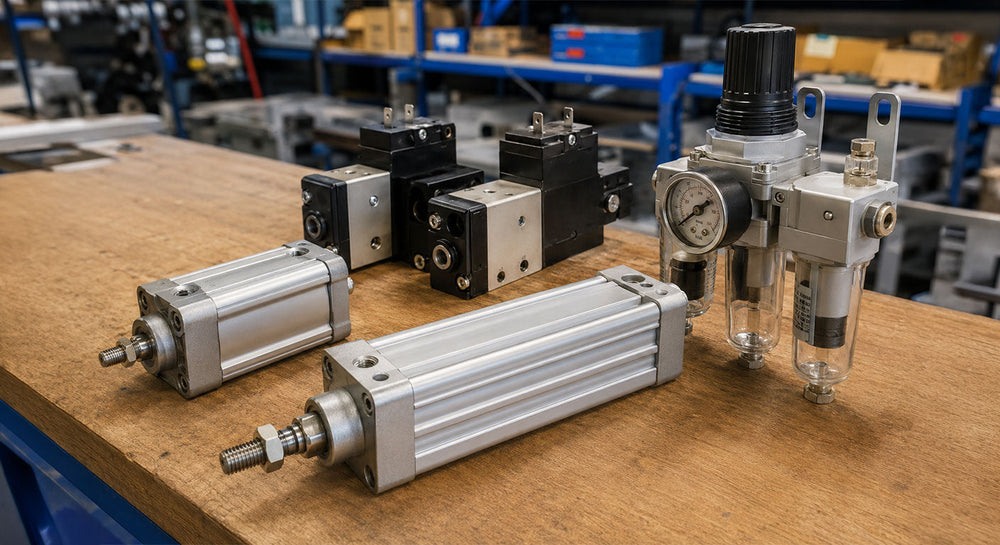
Pneumatic systems tend to run in the background of a production line until something in the air circuit stops working correctly, and then the whole station usually stops with it. A pneumatic solenoid valve that sticks, a pneumatic cylinder that loses seal integrity, or a degraded FRL unit feeding contaminated air downstream can each bring an actuator to a halt in ways that appear identical to the operator, even though the root cause and the fix are completely different.
Deciding whether to repair or replace a failed component isn't unique to pneumatics, but pneumatic circuits make the decision harder to get right, since the root cause is rarely obvious from the symptom alone. The same discipline covered in 7 Easy Tips for Troubleshooting PLC Systems applies here too: isolate the component and test it directly before assuming it's the point of failure, since replacing a part that was never actually broken doesn't fix anything.
Pneumatic components are mechanically simpler than most electronic automation hardware, but that simplicity is exactly why diagnosing a failure takes some care. A cylinder that won't extend fully could be a seal problem, a valve problem, or an upstream air quality issue, and treating the wrong one first just wastes a maintenance window.
What Causes a Pneumatic Solenoid Valve to Fail on an Installed System?
A pneumatic solenoid valve typically fails due to coil burnout, spool sticking from contaminated or under-lubricated air, or worn seals that let air bleed past the spool even when the valve is supposed to be sealed. These failures show up differently depending on where they occur:
A burned-out coil prevents the valve from shifting, so the actuator it controls simply doesn't move.
A sticking spool causes intermittent or sluggish actuation, which often looks like a timing problem before anyone traces it back to the valve.
Worn seals let air pass through in the wrong position, causing an actuator to drift or lose holding force even when the valve isn't actively commanded.
Because a solenoid valve sits between the control signal and the mechanical motion it produces, a valve failure can be mistaken for a PLC output problem or a wiring fault until the valve itself is tested in isolation.
Why Do Pneumatic Cylinders Lose Performance Over Time?
Pneumatic cylinder wear generally comes down to seal degradation, rod scoring, or internal contamination building up inside the bore. A cylinder with a worn piston seal will still move, but it loses force and speed as air bypasses the seal internally rather than driving the piston. Rod scoring, often caused by misalignment or debris, damages the rod seal each time the cylinder cycles, accelerating a leak that started small. In dusty or high-particle environments, contamination that gets past the rod wiper seal gradually wears the bore surface, which is a harder problem to fix than replacing an external seal.
A pneumatic cylinder that cycles thousands of times per shift, as is typical on packaging and assembly lines, wears out much faster than one used intermittently, so replacement intervals vary significantly by application, even for the same cylinder size.
What Does an FRL Unit Do, and Why Does Air Quality Matter for Pneumatic Components?
An FRL unit, short for filter, regulator, and lubricator, conditions compressed air before it reaches the downstream valves and cylinders. The filter stage removes particulate and moisture, the regulator stage sets and stabilizes output pressure, and the lubricator stage adds a controlled amount of oil mist for components that require it. When an FRL unit degrades, whether from a clogged filter element or a regulator that no longer holds pressure steadily, every downstream component is exposed to worse air quality or unstable pressure than it was designed to handle.
This is why solenoid valve and cylinder failures sometimes trace back to an FRL unit rather than to the component that actually failed. A contaminated upstream filter element can accelerate valve spool wear for months before the valve itself fails, making the FRL unit one of the first things to inspect when pneumatic failures start clustering in the same area of a plant.
What Should I Confirm Before Ordering a Replacement Pneumatic Component?
Matching a replacement pneumatic solenoid valve, cylinder, or FRL unit correctly depends on a few specifications that are easy to overlook if only the port size is checked:
Port size and thread type must match the existing manifold or fitting.
The operating pressure range must cover the circuit's actual operating pressure, not just the component's rated maximum.
Stroke length and bore diameter must match for cylinders, since a close-but-not-exact size will often mount but won't deliver the same force or travel.
Voltage and connector type must match for any solenoid-actuated valve.
Pulling these details from the failed component's nameplate before ordering is the fastest way to avoid a second order. PLC Direct carries pneumatic solenoid valves, cylinders, and FRL units from Festo, supporting replacement and maintenance needs across industrial automation systems.
What Condition Grade Makes Sense for a Pneumatic Component?
A valve on a bottleneck line carries more downtime risk than a cylinder on a lower-priority station, since a failure at the valve halts the line entirely. A cylinder on a lower-priority station tolerates more of that risk. PLC Direct grades its pneumatic hardware to reflect that: Sealed Surplus, Never Used Surplus, and Used/Refurbished.
Sealed Surplus stock stays in its original factory packaging, even if the batch itself is from an earlier production run. Never Used Surplus components have never gone into service, but the factory seal isn't guaranteed to still be intact. Used/Refurbished units go through inspection and testing before they're cleared for resale.
All three condition grades carry the same coverage: a standard 1-year PLC Direct warranty covering defects and functionality, applicable to Sealed Surplus, Never Used Surplus, and Used/Refurbished products. This warranty is issued by PLC Direct, an independent supplier, and is not an OEM or manufacturer warranty.
If a solenoid valve, cylinder, or FRL unit needs to be replaced on a pneumatic circuit, PLC Direct can help track down the right match. Contact PLC Direct with your part number to check availability and get a quote, subject to inventory.
