
 1-year warranty

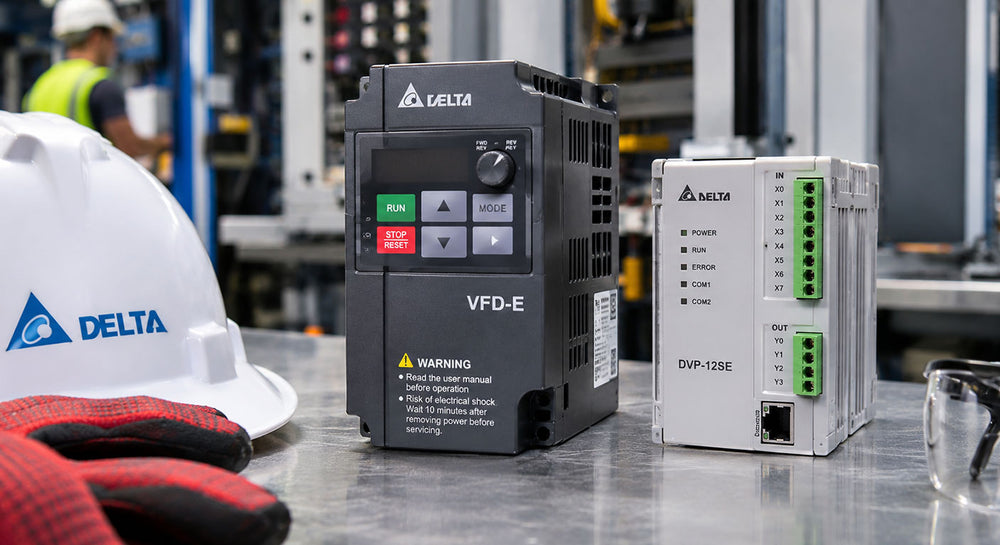
Delta’s automation lineup includes two separate PLC platforms and several generations of VFDs, and none of them are substitutable. Delta’s DVP and AS controllers are two separate PLC platforms. Delta’s DVP controllers can be programmed through either WPLSoft or ISPSoft, Delta’s IEC 61131-3-compliant programming environment for Delta’s DVP, AS, and AH series PLCs. A project built for the DVP series doesn’t carry over to the AS series, so sharing the same software doesn’t make the two platforms interchangeable. On the drive side, an older VFD-B or VFD-E unit needs a confirmed cross-reference before substitution, since even a matching horsepower and voltage rating doesn’t guarantee the same mounting dimensions or terminal layout. Before placing an order, the question isn’t whether a part is Delta hardware, it’s whether it’s the right DVP or AS controller, or the right VFD series, for the system that’s already installed.
What information do you need before ordering a replacement Delta PLC?
Start by confirming which platform is installed. Delta’s DVP series is a compact, brick-style controller line that can be programmed through WPLSoft or through ISPSoft, Delta’s IEC 61131-3-compliant environment for Delta’s DVP, AS, and AH series PLCs. Even within ISPSoft, a project built for one series is not interchangeable with another, so the series designation printed on the module matters more than which programming tool is in use.
Beyond the platform and series, match the I/O point count and available communication ports (RS-232, RS-485, or Ethernet, depending on the model), since expansion modules are designed for a specific series rather than the platform as a whole.
What information do you need before ordering a replacement Delta VFD?
The model number on a Delta drive encodes its series, its power or current rating, and its voltage and phase class, and all three need to match the unit being replaced. Delta’s drive lineup splits clearly into discontinued and current series.
-
VFD-B is a discontinued series, officially replaced by Delta’s MS300, MH300, or C2000 Plus lines depending on the application. VFD-C200, by contrast, is Delta’s current light-duty replacement for VFD-B, not a legacy series itself, so the two shouldn’t be grouped together when sourcing a replacement.
-
VFD-C2000 and VFD-C2000+ series feature precise speed, torque, and position control functions suitable for both sensor and sensorless synchronous/asynchronous motors, with a power range reaching up to 560 kW for heavy-duty and constant-torque applications. Confirming Delta’s current catalog or an authorized distributor before ordering is still worth doing.
-
A “VFD-C” designation alone isn’t enough to tell whether a given unit is legacy or current; the full series name matters.
When a discontinued series needs cross-referencing to an available replacement, checking mounting dimensions and terminal specifications against the original unit matters more than relying on a matching horsepower rating alone.
The nameplate is the most reliable source for the original series and rating; where it’s worn or missing, the cabinet’s as-built documentation is the next place to check.
How do you confirm a part has actually failed before ordering a replacement?
A PLC or VFD that appears dead may be responding to a problem elsewhere rather than failing on its own. On a DVP or AS controller, check the status LEDs against Delta’s documented fault codes before assuming the CPU or an I/O module has failed, since a communication fault further down the line can make a working module appear unresponsive.
On a VFD, rule out the incoming supply and motor wiring first, since an out-of-range line voltage or a shorted motor lead can trip a drive in a way that mimics an internal fault. Once those external checks come back clean, a persistent fault is the strongest signal that the hardware itself needs replacing rather than working around.
Why does this matter for procurement and maintenance teams?
Procurement teams sourcing on brand and horsepower alone can end up with a VFD-B unit pulled for a cabinet built around VFD-C2000 hardware, or an AS series expansion module that won’t talk to an installed DVP CPU. Neither mismatch shows up until the part arrives and gets wired in, which turns an already time-sensitive repair into two separate sourcing attempts instead of one.
Once the series and specifications are confirmed, contact PLC Direct to check current availability and get a quote.
What do PLC Direct’s condition grades mean for Delta hardware?
PLC Direct supplies industrial automation hardware in three condition grades: Sealed Surplus, Never Used Surplus, and Used/Refurbished, describing packaging and use history only, not safety ratings, calibration, or regulatory certifications. All three carry the same 1-year PLC Direct warranty, issued by PLC Direct as an independent supplier and not an OEM warranty; see the full PLC Direct Condition Grades guide for details on each grade.
