
 1 year warranty

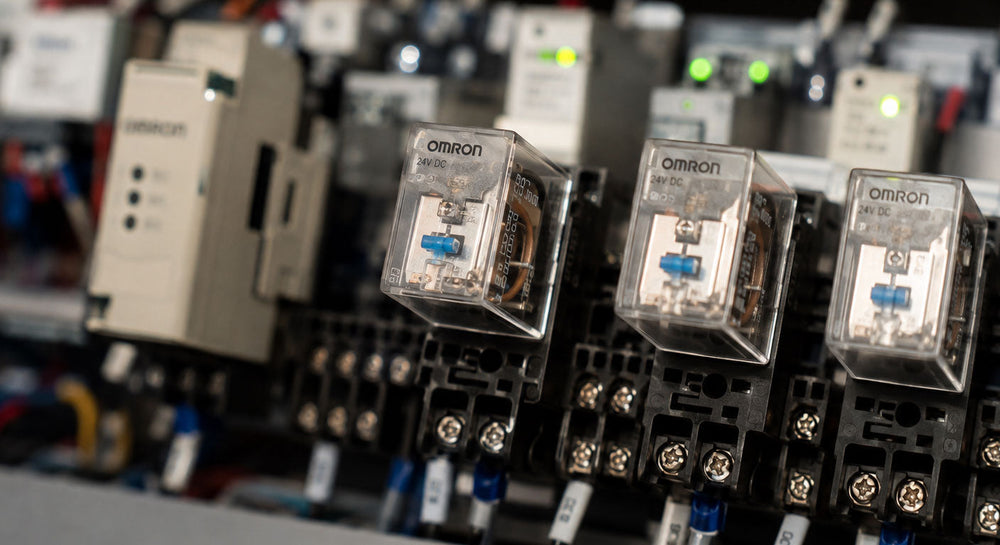
A relay is one of the smallest components in a control panel and one of the easiest to overlook, right up until it stops switching the way it should. A general-purpose relay that fails might just stall a single circuit. A safety relay that fails can quietly disable an emergency stop or a guard interlock without giving any obvious sign that the protection it was providing is gone. Either way, the relay itself rarely gets attention until something downstream stops working the way it’s supposed to.
An Omron relay switches an electrical circuit on or off in response to a control signal, and Omron’s lineup spans general-purpose control relays used throughout standard panel wiring as well as safety relays built specifically for emergency stop, interlock, and guarding circuits. This guide covers what to know when selecting an Omron industrial relay for an existing installation, including how condition grades work and what to check before ordering a replacement.
What Types of Omron Relays Does PLC Direct Carry?
PLC Direct’s Omron relay offering generally includes both general-purpose control relays and safety relays, which serve different purposes in a panel. General-purpose control relays handle standard switching duties, such as interposing between a PLC output and a higher-current load or providing electrical isolation between circuits. Safety relays are purpose-built for safety-related circuits, monitoring inputs such as emergency stop buttons, safety light curtains, or guard door switches, and controlling outputs to meet a defined safety performance level.
These two relay types are not interchangeable. A general-purpose relay used in place of a safety relay will not provide the monitoring and fault-detection behavior that a safety circuit depends on, regardless of how similar the two components might look on a panel.
What Should You Check Before Ordering a Replacement Omron Relay?
Getting a replacement relay right comes down to matching the original unit’s coil voltage, contact configuration, and mounting base, along with confirming the safety category if the relay is part of a safety circuit. A relay that looks similar but doesn’t match on these points can fail to switch the load correctly or, in a safety application, fail to provide the protection the circuit was designed around.
-
The coil voltage must match the control circuit’s supply; AC and DC coil versions are not interchangeable, and running the wrong voltage can damage the coil.
-
The contact configuration matches whether the original relay uses single-pole or multi-pole contacts and whether the wiring is normally open or normally closed.
-
The mounting style matches, since plug-in relays depend on a compatible socket or base already installed in the panel.
-
For a safety relay specifically, the safety category or performance level matches the original unit, since it determines the relay’s fault detection and monitoring behavior in the circuit.
Checking the nameplate on the failed relay directly is more reliable than relying on a panel drawing alone, particularly in older installations where a relay may have been swapped for a similar but not identical model at some point in the panel’s history.
Sealed Surplus, Never Used Surplus, or Used/Refurbished: Choosing a Condition Grade
Omron general-purpose control relays are available in three condition grades. Sealed Surplus units arrive in the original, sealed box, though boxes may show shelf wear, and manufacturing dates vary. Never Used Surplus units have not been used or refurbished and may or may not include original packaging. Used/Refurbished units have been inspected, tested, and restored to working condition, covering both previously used and refurbished relay hardware.
These same three grade labels apply to safety relays as well, but there they describe packaging and use history only. Safety category and fault-detection performance are not part of the condition grade and must be verified separately against the original unit, regardless of which grade is selected.
The right grade comes down to packaging preference and budget. Choose Sealed Surplus when factory-sealed packaging is preferred, or Never Used Surplus and Used/Refurbished when original packaging matters less.
All Sealed Surplus, Never Used Surplus, and Used/Refurbished Omron relays purchased from PLC Direct carry a standard 1-year PLC Direct warranty. This warranty is issued by PLC Direct, an independent supplier, and is not an OEM or manufacturer warranty.
PLC Direct supplies Omron relays and other automation hardware for replacement and maintenance purposes and does not provide system design, programming, or integration services.
Matching the Relay to the Circuit It Protects
Whether it’s a general-purpose relay switching a routine load or a safety relay monitoring an emergency stop circuit, the right replacement is the one that matches the original in every detail that matters to how the circuit behaves. Contact PLC Direct to check current availability on Omron relays and get a quote for your application.
