
 1 year warranty

Electric motors drive the pumps, fans, compressors, and conveyors that industrial facilities depend on every operating hour. Understanding the main motor starter types and where each belongs in an installed system is the starting point for making the right hardware decision. The wrong device for the application shows up quickly: premature motor failures, inrush current problems on the supply system, or a drive specified for speed control where only a managed start was needed.
The soft starter vs VFD question sits at the center of many motor control projects, from new installations to direct component replacements. VFD motor control delivers continuous speed variation throughout the operating cycle; a soft starter manages only the startup transition. This guide covers how each technology works, which applications suit each, and what to confirm before sourcing replacement hardware.
What Are the Main Motor Starter Types?
Motor starter types fall into three primary categories: direct-on-line starters, soft starters, and variable frequency drives. Each determines how an AC motor connects to the power supply at startup and, for VFDs, how it operates throughout the full production cycle.
-
Direct-on-line (DOL) starters: Apply full line voltage at startup, generating an inrush current 6 to 10 times the motor's rated current. The torque surge is transmitted directly to the shaft and the connected equipment. DOL starting is the simplest and lowest-cost option, suitable only for small motors on loads that can withstand a hard start.
-
Star-delta starters: Reduce starting current by initializing in a star configuration, then switching to delta at speed. A torque step occurs during the transition, and there is no speed control during operation.
-
Soft starters: Ramp voltage progressively during startup to limit inrush current and mechanical shock. An internal bypass relay engages once the motor reaches full speed, and the soft starter plays no further role until the next start cycle.
-
Variable frequency drives (VFDs): Control motor speed by varying both frequency and voltage throughout the operating cycle. VFDs provide soft starting as a standard function and also offer full-speed control, energy management, and motor protection.
Soft starters and VFDs cover most motor-control decisions in industrial equipment. Understanding the distinction between them is where the majority of hardware selection mistakes are avoided.
How Does VFD Motor Control Work?
A VFD controls motor speed by varying the frequency and voltage supplied to the motor. It converts incoming AC to DC, then inverts it back to AC at the required frequency, allowing the motor to run at any speed within its rated range at any point in the production cycle.
VFD motor control offers several capabilities beyond basic soft starting:
-
Variable speed on demand: The motor runs at the speed the process requires, not a fixed nameplate speed.
-
Energy savings for variable-torque loads: For pumps and fans, the Affinity Laws mean power scales with the cube of the rotational speed. A motor running at 80% speed draws roughly half the power required at full speed.
-
Built-in soft start: Frequency and voltage ramp from zero, eliminating the need for a separate soft starter in the same circuit.
-
Motor protection: Built-in overload detection, fault logging, and thermal monitoring.
-
Process integration: Most units accept analog or digital speed reference signals for direct connection to PLC or SCADA systems.
VFDs are well-suited for pumps, fans, conveyors, extruders, and mixers where process demand varies and motor speed needs to follow it. For constant-speed applications, the energy savings that make VFDs cost-effective on variable loads do not apply.
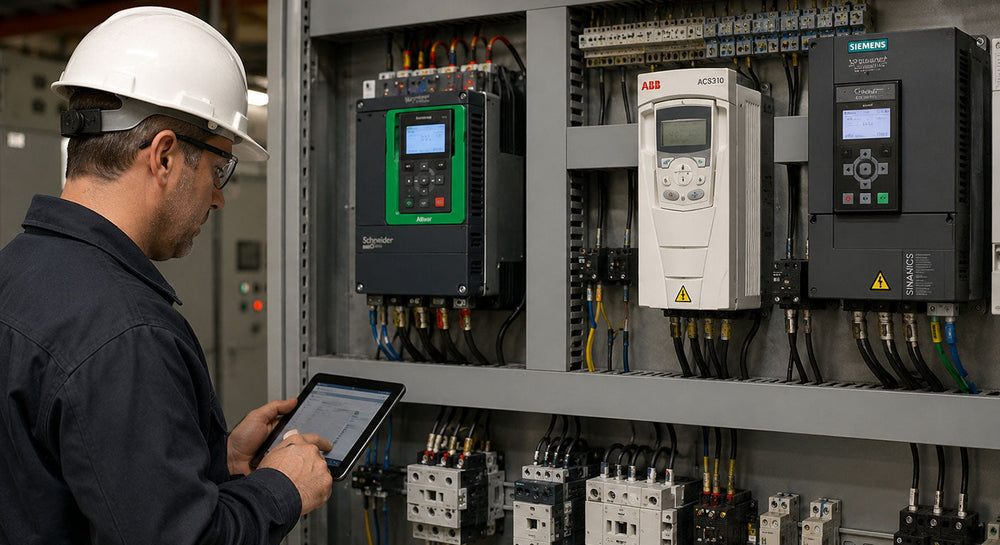
VFDs available through PLC Direct include the Schneider Electric Altivar 61 (ATV61), optimized for pumping and ventilation, and the Altivar 71 (ATV71) for complex, high-power machine applications. ABB's ACS310 and ACS355 cover a broad range of AC motor control requirements. The Siemens SINAMICS range spans general-purpose drives through the SINAMICS S120 for coordinated multi-axis applications.
What Does a Soft Starter Do, and Where Does It Belong?
A soft starter controls the voltage applied to a motor only during the start cycle. It ramps voltage progressively to limit inrush current and reduce mechanical torque shock on the motor and connected equipment. Once the motor reaches full operating speed, an internal bypass relay engages, and the soft starter steps out of the circuit until the next start.
Key functions a soft starter provides:
-
Inrush current limiting: Reduces starting current from the DOL range of 6 to 10 times rated current down to typically 2 to 4 times rated current.
-
Mechanical stress reduction: Protects couplings, gearboxes, and belt-driven equipment from startup torque surge.
-
Demand charge reduction: Lowers the peak current drawn from the supply system at each start.
-
Soft stop (available on most units): Controls deceleration to prevent water hammer in pump applications.
A soft starter does not control motor speed during operation. For applications where full-speed operation is the only requirement and controlled starting is the problem to solve, a soft starter delivers it at a lower cost and with a smaller footprint than a VFD.
Soft starters available through PLC Direct include the Schneider Electric Altistart series (ATS48 and ATS480), the Siemens SIRIUS 3RW range, and ABB PSTX and PSR soft starters.
Soft Starter vs VFD: How Do You Choose the Right One?
The selection comes down to one question: Does the application require speed variation during operation, or only a controlled transition to full speed?
Choose a VFD when:
-
The process requires variable motor speed, such as flow control on a pump, adjustable conveyor speed, or variable fan pressure.
-
Energy savings from a variable-torque load need to be captured across the operating cycle.
-
The application requires speed regulation in response to process feedback signals.
-
Multiple protection and diagnostic functions are needed from a single device.
Choose a soft starter when:
-
The motor runs at full speed during operation, and speed variation is not required.
-
Budget or panel space limits the use of a VFD.
-
The primary requirement is protecting the motor and supply system from startup inrush.
-
Pump applications require a soft stop to prevent water hammer on deceleration.
On lifecycle cost: a VFD has a higher upfront cost, but energy savings from variable-torque loads can offset that over time. For constant-speed, constant-torque applications, that payback calculation does not hold, and a soft starter is the more cost-effective hardware choice.
What Should You Know Before Sourcing Motor Control Hardware?
Before ordering a replacement VFD or soft starter, confirm the following against the installed equipment:
-
Motor-rated current or kW/HP: The replacement device must be rated for the motor's full-load current.
-
Supply voltage and frequency: Must match the replacement unit's input specification.
-
Load type: Centrifugal (variable torque), constant torque, or high inertia. This affects both VFD parameter requirements and the selection of the soft starter starting class.
-
Existing installation details: For VFDs, note whether the circuit includes a bypass contactor, output reactor, or EMC filter. For soft starters, confirm the starting class required for the load.
PLC Direct is an independent supplier of industrial automation hardware, not an authorized distributor for any manufacturer. Hardware is available as surplus sealed, refurbished, and used. Surplus sealed units are factory-sealed stock; refurbished units have been tested and restored to operational condition. All products carry a 1-year PLC Direct warranty. This is not an OEM or manufacturer warranty. For teams managing older installed systems, PLC Direct's collection covers legacy and hard-to-find units across the Schneider Electric, ABB, and Siemens product lines.
Conclusion
Choosing between a soft starter and a VFD is a functional decision based on what the application requires. VFD motor control belongs where speed variation, energy management, or process integration are part of the operating requirement. Soft starters belong where controlled starting is the objective and the motor runs at full speed through the production cycle. Getting that match right before the order is placed protects connected equipment, reduces failure rates, and keeps motor control costs in line. If you are sourcing replacement drives, soft starters, or other motor control hardware for an installed system, contact PLC Direct to check availability.
