
 1 year warranty

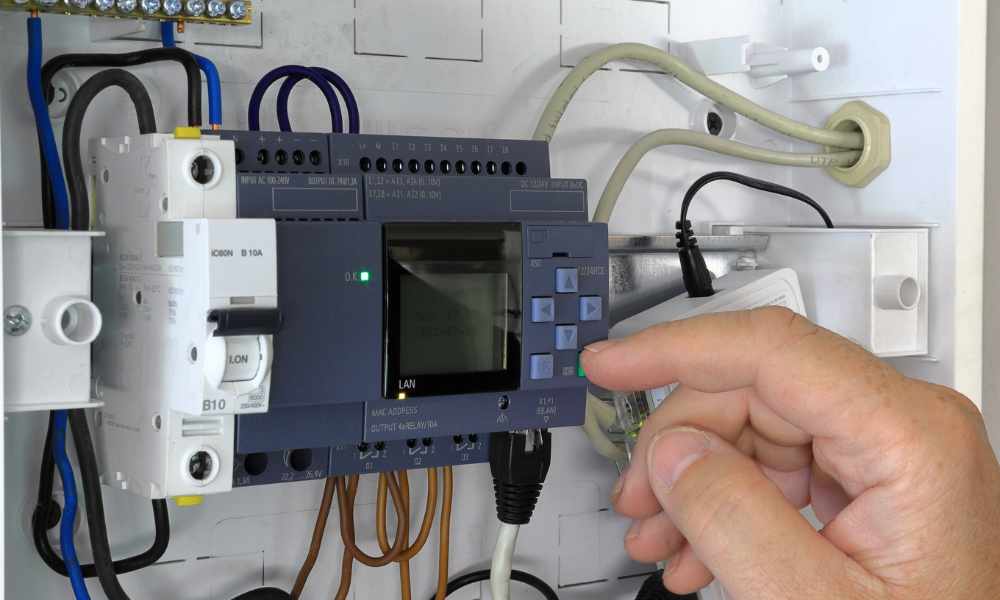
Not every automation application calls for a full-rack modular controller. Packaging lines, small-batch processing equipment, conveyor sections, pump stations, and standalone machines often require precise, reliable control in a physical footprint that a large PLC chassis cannot accommodate. A mini programmable logic controller delivers the core capabilities of a standard controller, including discrete and analog I/O handling, communication protocol support, and deterministic program execution, within a compact housing designed for space-constrained installations.
For procurement managers and maintenance engineers evaluating automation options for smaller-scale or distributed applications, here are the key advantages a mini PLC delivers.
What Makes a Mini PLC Easier To Install Than a Standard Controller?
The most immediate characteristic of a mini PLC is its physical footprint. Where a modular PLC system may occupy a full DIN rail section or require a dedicated enclosure panel, a mini programmable logic controller typically mounts on a short DIN rail segment and integrates into existing control cabinets without significant redesign.
This compact form factor reduces enclosure costs, simplifies cable routing, and makes the controller accessible in installations where panel space is genuinely limited. Mitsubishi Electric MELSEC FX3U and FX5 series controllers are built around a compact base unit with push-in I/O terminals and an integrated power supply, allowing installation in equipment panels where a larger controller would not fit. Siemens SIMATIC S7-1200 follows a similarly space-efficient design with a modular signal board architecture that allows I/O expansion without significantly increasing the controller's base footprint.
Is a Small PLC a Cost-Effective Option for Smaller Applications?
A small PLC is a cost-effective option for applications that do not require the processing capacity, I/O density, or communication redundancy of a full-scale controller. Purchasing a controller sized to the actual application, rather than over-specifying for headroom that will never be used, reduces both upfront hardware cost and ongoing maintenance overhead.
For small- to medium-sized operations automating specific process stages rather than entire production lines, a mini PLC provides the necessary control capability without the cost of larger platform deployments. Schneider Electric Modicon M221 and M241 controllers cover common machine control requirements, including discrete I/O, analog inputs, and Ethernet connectivity, at a price point suited to budget-constrained applications.
Sourcing surplus sealed or refurbished mini PLC hardware extends these cost advantages further. Surplus sealed units are factory-sealed stock available at a lower cost than current-production hardware, while refurbished units have been tested and restored to operational condition and carry a 1-year PLC Direct warranty.
How Flexible Is a Mini Programmable Logic Controller Across Different Applications?
Mini PLCs are not limited to simple on/off control. Modern small PLC platforms support structured text and function block programming under IEC 61131-3 standards, handle both digital and analog I/O, and communicate over industrial protocols including Modbus TCP/IP, EtherNet/IP, and PROFIBUS, depending on the platform.
This makes a mini programmable logic controller adaptable across a range of applications: conveyor sequencing, temperature control loops, batch dosing, pump alternation, and equipment interlocking. Omron Sysmac NX1P2 is a compact controller that supports EtherCAT motion control alongside standard machine control logic, allowing coordinated axis control in a physically small package.
The ability to program the controller to a specific application and expand I/O incrementally as requirements grow means a mini PLC can scale with operational needs without requiring a platform change.
How Does a Small PLC Improve Productivity and Operational Efficiency?
Mini PLCs execute tasks faster and more accurately than manual operation, and they do so continuously without the variability introduced by operator fatigue or shift changes. For repetitive processes where consistency directly affects output quality, such as fill-level control, label verification, or timed conveyor indexing, deterministic execution is a direct contributor to throughput and product consistency.
Continuous operation also means that process data, alarm histories, and equipment status are logged and available without requiring an operator to be physically present at the machine, which supports both productivity monitoring and maintenance planning.
What Remote Access and Monitoring Capabilities Do Mini PLCs Offer?
A mini PLC offers remote access and monitoring capabilities that allow maintenance engineers and plant supervisors to observe equipment status, review alarm logs, and, in some configurations, adjust process parameters from a remote location. This is particularly valuable for distributed installations where multiple small machines or pump stations are spread across a facility or across multiple sites.
Remote visibility reduces the time between fault occurrence and diagnosis, shortening response time, and limiting unplanned downtime. Most current small PLC platforms support Ethernet-based communication that integrates with SCADA systems or HMI panels, providing a centralized view of distributed equipment without requiring dedicated communication hardware at each node.
What Should Be Considered When Sourcing Mini PLC Hardware?
When sourcing a mini PLC for a new installation or as a maintenance replacement, the key specification variables are I/O count and type, communication protocol requirements, power supply voltage, and operating environment rating. For replacement applications, the installed unit's part number is the most reliable starting point, as it encodes the I/O configuration and firmware generation.
PLC Direct stocks surplus sealed, refurbished, and used mini PLC hardware across platforms, including Siemens SIMATIC S7-1200, Schneider Electric Modicon M221 and M241, Mitsubishi Electric MELSEC FX3U and FX5, and Omron Sysmac NX1P2, along with associated expansion I/O modules and communication accessories.
Conclusion
Mini PLCs address a genuine gap in automation hardware: applications that require reliable, programmable control where space, budget, or application complexity does not justify a full-scale controller. PLC Direct supplies surplus sealed, refurbished, and used mini PLC hardware and associated automation components across leading compact platforms. To check availability on a specific part number or discuss sourcing options, reach out to PLC Direct.
