
 1 year warranty

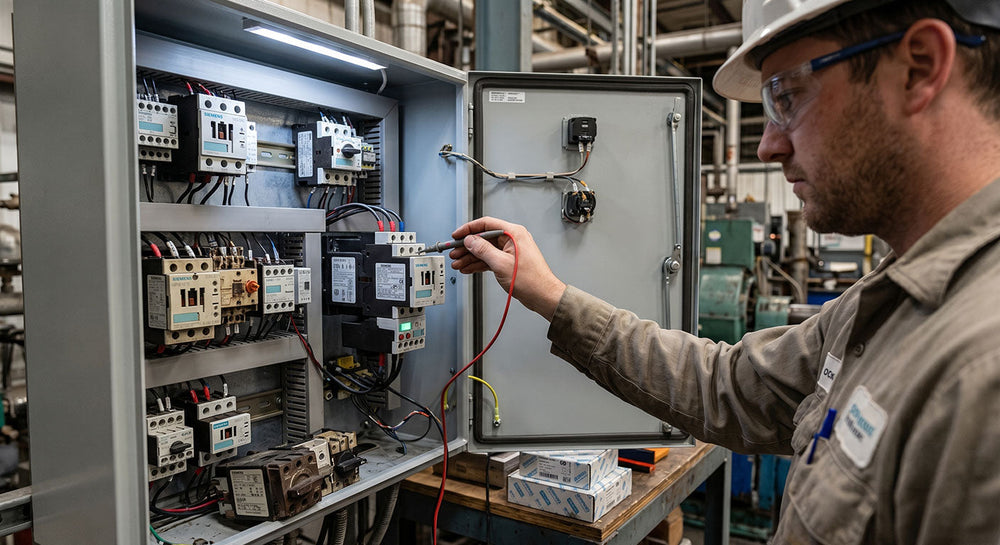
Industrial motor control systems are among the highest-frequency switching environments in any plant or facility. Motor starters and contactors handle every start and stop event across conveyor drives, pump stations, compressor circuits, and HVAC systems, and they do so continuously across multiple shifts, often for years without scheduled replacement. When one fails, the motor it controls goes offline immediately, and the downstream impact on production or operations follows within minutes.
Maintenance engineers and procurement teams managing installed motor control systems face a recurring sourcing challenge: the components that fail most often are highly specification-dependent, and a mismatch in coil voltage, current rating, or pole configuration means the replacement cannot be installed without additional rework. Motor starter replacement and contactor sourcing decisions are time-sensitive, and the ability to source compatible hardware from available stock can be the difference between a contained repair and a prolonged outage. PLC Direct supplies surplus sealed, refurbished, and used motor starters and contactors from brands commonly installed in industrial motor control systems.
What Are Motor Starters and Contactors, and How Do They Work Together?
Motor starters and contactors are both electrical switching devices used to control industrial motors, but they serve distinct functions in a motor control circuit. A contactor is an electrically operated switch that opens and closes a circuit to start and stop a motor. A motor starter combines a contactor with overload protection, adding a layer of fault management that disconnects the motor if current exceeds a safe operating threshold.
In a typical motor control circuit, these components work together as follows:
-
The contactor handles power switching, connecting and disconnecting the motor from its power supply.
-
An overload relay continuously monitors motor current and trips the circuit if an overload condition occurs.
-
A motor starter is the combined assembly of a contactor and an overload relay, providing both switching and protection in a single unit.
When either the contactor or the overload relay within a starter assembly fails, the entire motor circuit is affected. Replacement requires matching the original component's specifications precisely to maintain circuit protection and operational continuity.
What Causes a Motor Starter Replacement to Become Urgent?
Motor starter replacement is typically necessary due to contact wear, coil failure, or overload relay degradation, each of which develops at different rates depending on the duty cycle and operating environment. In high-cycle applications where motors start and stop frequently, contact wear accelerates significantly compared to low-cycle, continuous-run applications.
The most common failure triggers that drive an urgent motor starter replacement include:
-
Contact Wear or Welding: Arcing during switching erodes contact surfaces over time; in extreme cases, contacts weld shut, and the motor cannot be de-energized
-
Coil Failure: The electromagnetic coil that drives contactor actuation can fail due to voltage spikes, heat, or age
-
Overload Relay Trips That Do Not Reset: A relay that continues to trip after thermal reset may have internal damage requiring component replacement
-
Mechanical Wear: Spring fatigue and hinge wear affect the contactor's ability to fully open and close under normal switching conditions
Understanding the failure mode matters for ordering correctly. A welded contact requires a replacement contactor or contact kit. A failed coil may only require a coil replacement rather than a full starter assembly.
What Does Industrial Contactor Sourcing Involve?
Industrial contactor sourcing for an installed system starts with identifying three variables that determine compatibility: the current rating, the coil voltage, and the pole configuration. Getting any one of these wrong results in a component that cannot be installed directly into the existing circuit without additional modification.
Key parameters to confirm before placing an order:
-
Current Rating (AC-1 or AC-3 Duty): AC-3 ratings apply to squirrel cage motor applications, the most common industrial use; AC-1 ratings apply to resistive loads
-
Coil Voltage: The control voltage that actuates the contactor must match the control circuit; common ratings include 24V DC, 110V AC, and 230V AC
-
Pole Configuration: 3-pole contactors are standard for three-phase motor circuits; 4-pole configurations are used in specific applications
-
Auxiliary Contacts: Many installations rely on auxiliary contact blocks for interlocking, signaling, or status feedback; confirm the existing configuration before ordering
-
Mounting and Frame Compatibility: replacement units must fit the existing mounting footprint and DIN rail or panel configuration
Industrial contactor sourcing from surplus or refurbished stock follows the same verification process as OEM sourcing. The unit's condition grade determines its service history, but the electrical and mechanical specifications must still match the installed system exactly.
What Is the Siemens SIRIUS Motor Starter Range?
The Siemens SIRIUS motor starter range is part of the SIRIUS industrial controls portfolio, covering the full range of motor control and protection hardware, from manual motor starters and contactors to soft starters and overload relays. SIRIUS products are widely installed across manufacturing, process, and utility environments and are among the most commonly encountered motor control platforms in facilities standardized on Siemens automation hardware.
Key product families within the Siemens SIRIUS motor starter and contactor range include:
-
SIRIUS Contactors (3RT series): Standard contactors for motor switching across a range of current ratings and coil voltages
-
SIRIUS Overload Relays (3RU / 3RB series): Thermal and electronic overload relays that pair with SIRIUS contactors to form complete motor starters
-
SIRIUS Manual Motor Starters (3RV series): Self-protected motor starters combining switching and short-circuit protection
-
SIRIUS soft starters (3RW series): Electronic soft starters for controlled motor acceleration and deceleration
-
SIRIUS Safety Relays (3TK series): Safety-rated switching devices for emergency stop and safety gate applications
PLC Direct stocks Siemens SIRIUS hardware as surplus sealed, refurbished, and used stock. The 3TK1 high-current contactor series, covering 800 A and 1000 A AC-1 duty applications, is also available, including accessories and spare parts spanning coils, contact pieces, arc chutes, and auxiliary switch blocks.
What Should Maintenance Teams Check Before Ordering Replacement Motor Control Hardware?
Ordering the correct replacement requires confirming parameters that go beyond matching a part number. Facilities running the same equipment for many years may find that the current product generation has changed, and a like-for-like order by part number alone may not account for hardware revisions.
Before placing an order, confirm:
-
Exact Part Number and Hardware Revision: Revisions within a series can affect contact ratings, auxiliary contact availability, and mounting dimensions.
-
Coil Voltage: verify against the control circuit voltage at the panel, not just the nameplate on the existing unit.
-
Current and Duty Class: Confirm AC-1 or AC-3 rating and amperage against the motor load being controlled.
-
Auxiliary Contact Configuration: Document the number and arrangement of NO and NC auxiliary contacts currently installed.
-
Accessory Compatibility: If replacing only a coil, contact kit, or overload relay, confirm compatibility with the specific series and variant of the installed contactor.
PLC Direct supplies Siemens SIRIUS hardware and motor control components as surplus sealed, refurbished, and used stock. All products are backed by a 1-year PLC Direct warranty. PLC Direct does not provide programming, configuration, or integration services; hardware is supplied for installation by the customer's engineering and maintenance teams.
Conclusion
Unplanned motor outages rarely give maintenance teams time to wait on lengthy procurement cycles. Having a reliable source for motor starter replacement parts and industrial contactor sourcing across installed platforms means a failed component becomes a contained repair rather than an extended production loss. PLC Direct stocks surplus sealed, refurbished, and used motor control hardware, including Siemens SIRIUS contactors, starters, and accessories. Contact PLC Direct to check availability.
