
 1 year warranty

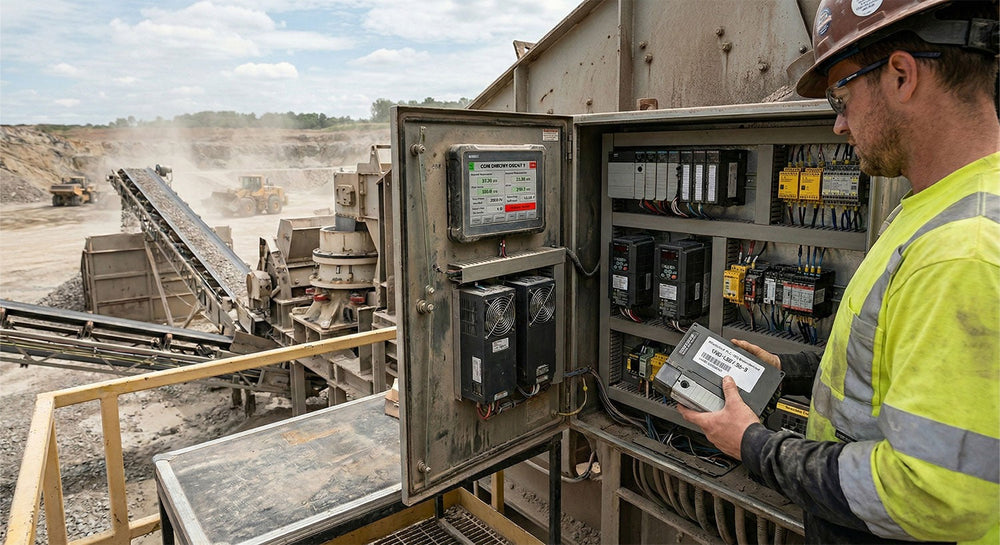
According to the U.S. Geological Survey's Mineral Commodity Summaries 2025, an estimated 1.5 billion tons of crushed stone valued at $26 billion was produced by approximately 1,400 companies operating 3,500 quarries across all 50 states in 2024. Behind that volume of output is a dense network of screening and crushing equipment running under continuous load, and the control systems that keep it coordinated, protected, and producing.
When those control systems fail or reach the end of life, operations stop. For maintenance and procurement teams managing aggregate and mining sites, sourcing reliable control hardware for crushing and screening applications is often the difference between hours of downtime and days.
The Role of Control Systems in Crushing and Screening Operations
Crushing and screening circuits rank among the most mechanically demanding environments in aggregate production and mining. Jaw crushers, cone crushers, impact crushers, and vibrating screens operate under sustained load, generating heat, vibration, and electrical noise that can cause significant stress on connected automation hardware.
Control systems in these applications are typically responsible for:
- Regulating crusher motor speed and load through variable frequency drives (VFDs)
- Monitoring conveyor belt tension, speed, and material flow\
- Managing interlock circuits that prevent unsafe operating conditions
- Logging production data, including throughput, operating hours, and fault history
- Coordinating feeder rates with downstream screening and conveyor systems
The PLC platform at the center of these functions is often integrated with remote I/O modules, operator HMI panels, motor control centers, and safety relay systems. Each component must remain compatible and operational for the circuit to function correctly.
Why Control System Upgrades and Replacements Are Common in Crushing Applications
Screening and crushing equipment is built for decades of service. It is not unusual for a primary crusher or screening circuit installed in the 1990s or early 2000s to still be fully operational today. The control systems tied to that equipment, however, follow a different lifecycle, creating a persistent procurement challenge.
Control system upgrades are often triggered not by equipment failure, but by the end-of-production status of the automation hardware itself. PLC platforms, operator interfaces, and drive controllers have defined production lifecycles. Once a model reaches end-of-production status, OEM availability contracts quickly. Maintenance teams at aggregate and mining sites then face a familiar set of problems:
- The original control hardware is no longer manufactured.
- Authorized distributor stock has been depleted.
- Manufacturer lead times for any remaining inventory are extended.
- Alternative models may not be firmware-compatible with existing PLC programs.
- Panel cutout dimensions may differ, requiring enclosure rework.
For operations running continuous production schedules, these are not abstract procurement concerns. Unplanned control system failures in crushing and screening circuits have a direct and immediate impact on throughput.
Control System Components Commonly Sourced for Crushing and Screening Equipment
A crushing and screening control architecture typically includes several layers of hardware, each with its own sourcing considerations.
PLC Platforms
The PLC is the core of most crushing circuit automation. Common platforms in long-running aggregate and mining installations include legacy Rockwell Automation systems, Siemens S7 series controllers, and Schneider Electric Modicon platforms. When an installed PLC platform reaches end-of-production, exact model replacement is often the only viable option to avoid reprogramming the entire control system.
Variable Frequency Drives (VFDs)
VFDs regulate motor speed on feeders, conveyors, and crusher drives. In crushing applications, precise speed control directly affects throughput and equipment protection. Drive replacement requires matching the original frame size, voltage rating, current rating, and communication protocol to avoid integration issues with the existing PLC program.
Operator HMI Panels
Operator interfaces in crushing and screening environments must withstand dust, vibration, and temperature variation. When installed HMI models are discontinued, replacement units need to match panel cutout dimensions, supported communication protocols, and firmware compatibility with the connected PLC platform.
Remote I/O Modules
Distributed I/O modules gather field data from sensors monitoring pressure, flow, temperature, and equipment status across the crushing circuit. Exact module replacement is typically required to maintain rack configuration and addressing structure.
Safety Relay and Interlock Hardware
Safety systems in crushing environments manage emergency stop circuits, guarding interlocks, and equipment isolation. Safety relay hardware must be replaced with verified, specification-matched components to maintain the integrity of the installed safety architecture.
Environmental Considerations for Hardware Selection in Crushing Environments
Crushing and screening operations present environmental conditions that directly influence hardware specification. Procurement and maintenance teams should verify the following for any replacement control hardware:
- Enclosure protection rating: IP or NEMA ratings appropriate for dust and particulate exposure
- Operating temperature range: Documented range must accommodate ambient conditions at the installation point
- Vibration tolerance: Manufacturer-specified vibration ratings for components mounted near heavy machinery
- Communication interface compatibility: Confirmed protocol support for the installed PLC and network architecture
- Power supply requirements: Voltage, current, and power supply compatibility with existing panel infrastructure
All specifications should be verified against the manufacturer's official documentation before procurement. Model number accuracy is essential; hardware sourced without confirmed specification alignment creates additional integration risk.
Lifecycle Planning for Crushing and Screening Control Infrastructure
Operations running legacy crushing and screening equipment benefit from proactive lifecycle planning for the associated control hardware. Key considerations include:
- Identifying PLC platforms, drives, and HMI models that are at or approaching end-of-production status
- Documenting exact model numbers, firmware versions, and communication configurations for installed hardware
- Assessing whether surplus sealed, refurbished, or used components are available for critical legacy models
- Evaluating lead times from available supply sources before a failure event creates urgency
Planning ahead for control system upgrades and hardware availability reduces the risk of extended downtime when components need to be replaced.
Sourcing Reliable Alternatives for Crushing and Screening Control Hardware
When OEM production has ended, and authorized distributor inventory has been exhausted, independent suppliers specializing in surplus and legacy industrial automation hardware become a practical sourcing channel for maintenance and procurement teams.
An independent supplier with inventory across the full automation ecosystem can assist with sourcing:
- Discontinued PLC platforms and processor modules
- Legacy-compatible VFDs and drive hardware
- Replacement HMI panels matched by model number.
- Remote I/O modules for established rack configurations
- Safety relay hardware and interlock components
- Communication modules supporting legacy and current industrial protocols.
All replacement components should be matched against the exact manufacturer model number and verified against official specifications before installation in crushing and screening control systems.
Conclusion
Control systems are a critical layer of infrastructure for crushing and screening equipment. As aggregate and mining operations continue to run equipment far beyond their original OEM support windows, maintaining reliable control hardware becomes an ongoing operational consideration.
Accurate model identification, specification verification, and access to surplus and legacy automation components help maintenance and procurement teams manage control system upgrades and sustain control system performance without disrupting production continuity.
If your team is sourcing replacement or legacy-compatible control hardware for crushing equipment, screening and crushing equipment, or related control system upgrades, verify exact model numbers and specifications against your installed system requirements before procurement.
PLC Direct supplies surplus sealed, refurbished, and used industrial automation hardware across the full automation ecosystem, including PLCs, VFDs, drives, motors, HMIs, I/O modules, sensors, safety systems, and networking equipment. All products are backed by a 1-year warranty.
For inquiries about availability or model-specific sourcing requests, contact us with your exact part numbers and technical requirements.
