
 1 year warranty

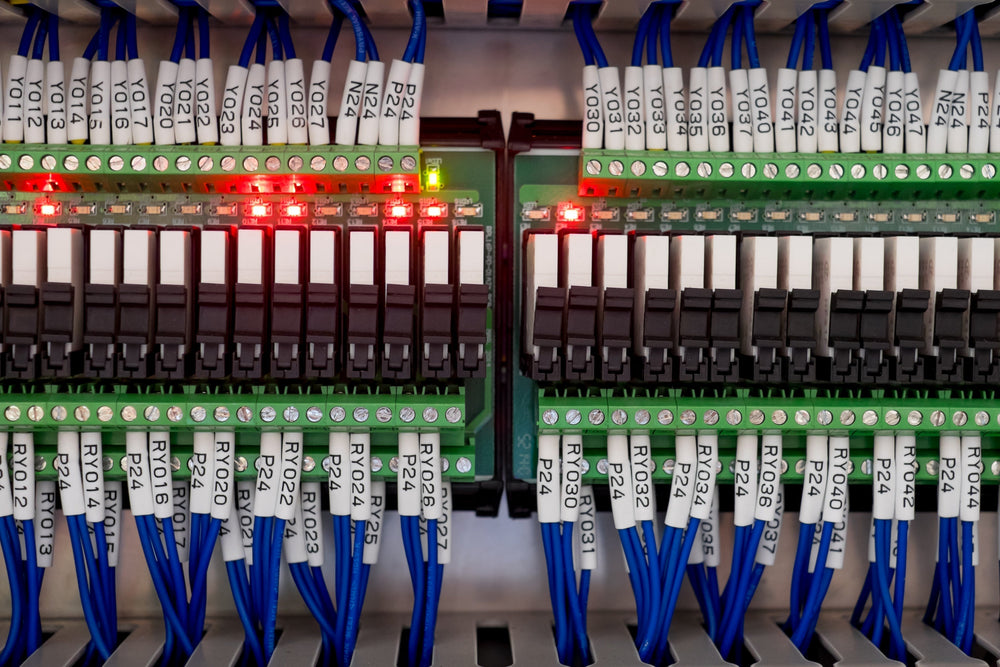
Industrial environments introduce safety hazards that standard operational controls cannot fully address on their own. Chemical plants, oil and gas facilities, mining operations, and heavy manufacturing all involve conditions where equipment failures, process deviations, or sensor faults can escalate rapidly into incidents affecting personnel, equipment, and the surrounding environment. In these settings, PLC safety architecture is not a supplementary feature. It is a core requirement of the control system design.
Programmable logic controllers, particularly safety PLCs, play a central role in achieving this. These specialized systems are designed to maintain operations under normal conditions and execute controlled, fail-safe shutdowns when predefined hazard thresholds are reached.
What Are Safety PLCs?
What are safety PLCs, and how do they differ from standard automation controllers? A safety PLC is a programmable logic controller specifically engineered to handle safety-critical tasks within an industrial system. It forms a fundamental part of a Safety Instrumented System (SIS), a layered safety architecture designed to monitor process conditions and execute protective actions when hazardous states are detected.
A safety PLC performs the same basic functions as a standard PLC: reading inputs, executing a program, and updating outputs. The difference lies in how those functions are implemented. Safety PLCs are built and certified to operate reliably under fault conditions, including hardware failures, wiring faults, and software errors, whereas a standard PLC would exhibit undefined behavior. The safety PLC receives inputs from field sensors, evaluates risk conditions against programmed safety logic, and initiates protective actions, such as stopping equipment or shutting down a process, to prevent harm to personnel, damage to machinery, or environmental releases.
What Makes a PLC a Safety PLC?
Several design characteristics distinguish a safety PLC from a standard automation controller:
Redundancy
Safety PLCs incorporate redundant hardware and software architectures. Critical processing and I/O functions have backups, ensuring that a single component failure does not result in loss of the safety function.
Safety Integrity Level (SIL) Certification
Safety PLCs are designed and certified to meet SIL ratings as defined by IEC 61508 and IEC 61511. SIL levels quantify the probability of a safety function failing on demand. Higher SIL ratings correspond to lower failure probability and are required for higher-risk applications.
Safety Logic Locking
Safety logic is protected against unauthorized or accidental modification. This prevents changes to safety-critical program elements outside of a controlled engineering process and preserves the integrity of the certified safety function.
Advanced Diagnostics
Safety PLCs continuously monitor for faults, including broken wires, failed contacts, short circuits, and sensor malfunctions. Detected faults trigger defined safe-state responses rather than undefined behavior.
Multi-Channel I/O Monitoring
Redundant input channels enable the controller to verify sensor signals independently, increasing confidence in the accuracy of the data used to drive safety decisions.
These features enable safety PLCs to meet international safety standards and allow them to be formally certified as part of an SIS design.
Where Are Safety PLCs Used?
Safety PLCs are deployed across a range of industries where process hazards require an independent, certified safety layer:
Manufacturing
In automated assembly lines, safety PLCs detect equipment malfunctions, guard zone intrusions, and emergency stop activations, initiating shutdowns that protect both workers and machinery.
Chemical Processing
Safety PLCs monitor critical parameters including pressure, flow rate, and temperature. When values exceed safe operating limits, the safety PLC triggers emergency shutdown procedures or activates alarms to prevent chemical spills or uncontrolled reactions.
Oil and Gas
Safety PLCs manage fire and gas detection systems, high-integrity pressure protection systems (HIPPS), and emergency shutdown (ESD) systems across upstream, midstream, and downstream operations.
Power Generation
Safety PLCs oversee reactor cooling systems, turbine trip logic, and emergency shutdown mechanisms in nuclear, thermal, and combined-cycle power plants.
Mining
Safety PLCs manage gas detection, conveyor emergency stops, and equipment interlock systems in underground and surface mining environments where hazardous conditions can escalate quickly.
Beyond process hazard management, PLC safety architecture also helps protect networked control systems from unauthorized access and cyber-related manipulation of safety functions, a growing concern in connected industrial environments.
Can a Standard PLC Be Used as a Safety Device?
A standard PLC cannot substitute for a safety PLC in a certified SIS application. Standard PLCs are not designed or certified to maintain defined behavior under fault conditions. They lack the redundancy, diagnostic coverage, and SIL-rated software architecture required for safety-critical functions. A safety PLC is required when the application demands a certified safety function, which is common in most high-hazard industrial processes.
For lower-risk applications where formal SIL certification is not required, standard PLCs with appropriate I/O and interlock logic may be sufficient. Determining the boundary between standard and safety PLC requirements is part of the hazard and risk assessment process for each installation.
Safety PLC Platforms Available Through PLC Direct
PLC Direct stocks surplus sealed, refurbished, and used safety PLC hardware across platforms used in certified SIS applications. Available brands include Siemens SIMATIC Safety (including safety-rated S7-300F and S7-400F variants), Pilz safety controllers, B&R safety PLCs, and Omron Sysmac safety-rated hardware. Associated safety I/O modules, safety relays, and communication components are also available across these platforms.
Safety instrumented systems require hardware that meets the certification standards required by the application. PLC Direct supplies surplus sealed, refurbished, and used safety PLC hardware and associated automation components to support SIS maintenance, legacy system sourcing, and installed-base continuity, with 1-year PLC Direct warranty. To verify availability on specific part numbers or request a quote, get in touch with PLC Direct.
