
 1 year warranty

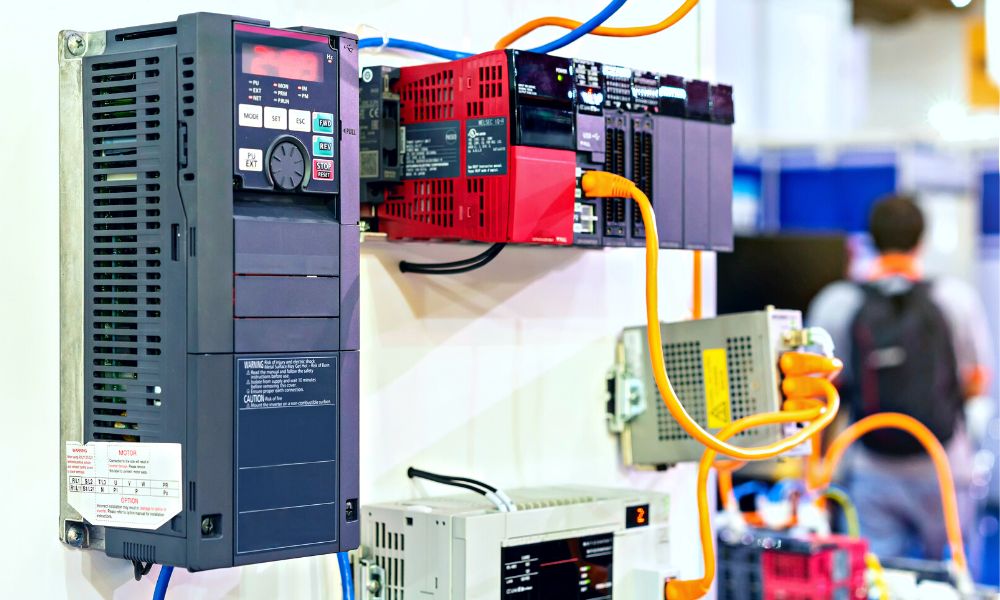
Programmable logic controllers are deployed across industrial manufacturing, food processing, water treatment, warehousing, and dozens of other applications. The range of available platforms reflects that breadth: compact micro-PLCs for simple machine control, modular mid-range systems for multi-axis production lines, and high-availability process controllers for continuous operations. Because no single platform fits every application, the selection of PLC hardware requires a structured evaluation before any purchase decision is made.
These five factors form the foundation of how to specify a PLC for a given application.
Factor 1: Define Your Application Requirements First
Those specifying a PLC for a food processing line are working from a fundamentally different set of requirements than those automating a metal fabrication cell. Control complexity, the number of devices to be managed, process speed, and regulatory environment all shape which platform is appropriate.
Before evaluating specific hardware, document the application clearly: what equipment needs to be controlled, what sequences need to be executed, what operator interface is required, and what the consequences of a control system fault would be. This scoping exercise drives every subsequent specification decision and serves as the starting point for any disciplined selection of PLC hardware.
Factor 2: Match the PLC to Its Operating Environment
It is critical to consider the environment in which a PLC will operate. Many PLCs are built for standard industrial environments with controlled temperature, moderate humidity, and limited vibration. However, in some industries, these conditions are not always present.
Excessive dust, vibration, and extreme temperatures all cause additional wear on PLC hardware over time. Facilities in mining, foundry, or outdoor infrastructure applications require hardware rated for harsh conditions. Siemens SIPLUS variants, for example, are designed for extended temperature ranges and elevated contamination levels compared to standard SIMATIC hardware. ABB AC500-XC controllers are similarly rated for extreme-condition deployments.
Confirming IP rating, operating temperature range, and vibration tolerance against the actual installation environment is a non-negotiable step in the specification process.
Factor 3: Calculate I/O Requirements Accurately
PLCs connect to field devices through input and output channels. Digital inputs read signals from pushbuttons, limit switches, and proximity sensors. Digital outputs drive solenoids, motor starters, and indicators. Analog inputs and outputs handle signals from instruments measuring pressure, temperature, flow, and position.
Getting the I/O count wrong at specification time creates problems at commissioning. The standard practice is to count confirmed I/O points from the field device list, add a contingency margin of 10 to 20 percent for future expansion, and then select a platform and I/O configuration that meets that total. Most modular PLC platforms, including Siemens SIMATIC, Schneider Electric Modicon, and Omron Sysmac, support distributed I/O architectures that allow the system to expand without replacing the central processor.
Understanding what are the 5 components of PLC hardware at a basic level, which are the processor, power supply, input modules, output modules, and communication interface, helps clarify exactly where I/O capacity constraints arise and how they can be addressed.
Factor 4: Evaluate Communication Protocol Support
Another vital factor when looking to buy PLC hardware for an existing facility is communication compatibility. A PLC that cannot communicate with the devices, networks, and supervisory systems already installed creates integration problems that add cost and delay to commissioning.
Common industrial protocols include Modbus RTU and TCP/IP, PROFIBUS, PROFINET, EtherNet/IP, and CANopen. Some PLC platforms support multiple protocols natively; others require additional communication modules. Confirming protocol support against the existing network architecture before purchase avoids specification errors that only surface during installation.
For facilities integrating PLCs with SCADA systems, HMIs, or enterprise-level manufacturing execution systems, the communication layer is as important as the controller's processing capability.
Factor 5: Verify Processing Speed Against Application Demands
Lastly, always verify a PLC's processing speed before finalizing the purchase. Scan cycle time, which is the time the processor takes to read inputs, execute the program, and update outputs, directly affects how quickly the control system can respond to field events.
For straightforward conveyor or pump control, a scan cycle of 10 to 20 milliseconds is typically sufficient. For high-speed motion control, press applications, or safety-critical interlock logic, sub-millisecond scan performance may be required. Computing speed can also vary depending on program size and the number of active communication connections, so reviewing the processor's rated scan time under loaded conditions, not just the published headline figure, gives a more accurate picture of real-world performance.
Memory capacity is a related consideration. Larger programs, data logging functions, and recipe management all consume controller memory, and selecting a processor with headroom for future program growth avoids the need for a hardware upgrade shortly after commissioning.
Where To Source PLC Hardware After Specification Is Complete?
Once the specification is finalized, sourcing options extend beyond OEM and authorized distribution channels. Independent suppliers stock surplus sealed, refurbished, and used hardware across major PLC platforms, which is particularly relevant for facilities that need to match an existing installed base, source a legacy platform no longer in active production, or manage procurement costs on a constrained budget.
A well-executed selection of PLC hardware reduces commissioning risk, supports long-term maintainability, and keeps sourcing options open for the life of the installation. PLC Direct supplies surplus sealed, refurbished, and used PLC hardware and automation components across leading platforms to support new builds, system expansions, and legacy maintenance. To check part availability or get a quote, submit a request through PLC Direct.
