
 1 year warranty

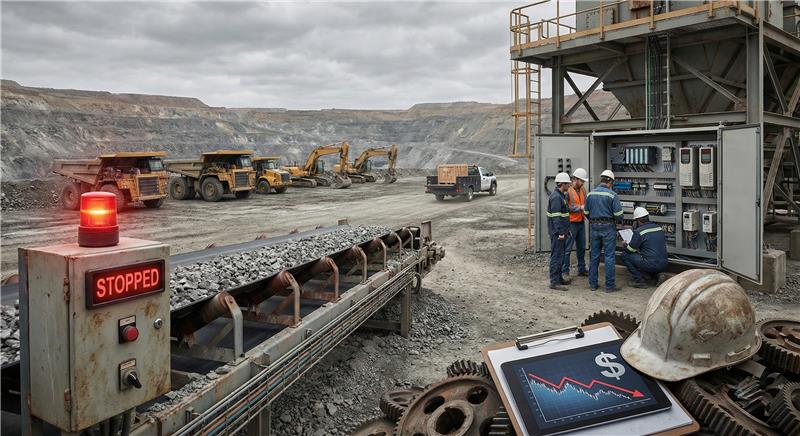
Unplanned downtime remains one of the most significant operational risks facing industrial organizations. According to a 2025 global survey published by ABB Group, unplanned outages can cost industrial businesses up to $500,000 per hour, with many facilities reporting recurring weekly disruption events.
In mining operations, financial exposure is often even greater due to the continuous and highly integrated nature of production systems. Crushing circuits, conveyor networks, grinding mills, pumping systems, and material handling infrastructure operate as interdependent assets. When a single critical automation component fails, whether a PLC processor, drive system, or communication module, the disruption extends across upstream and downstream processes, reducing throughput, interrupting material flow, and significantly increasing overall manufacturing downtime costs.
For mining operators, reducing machine downtime is therefore a strategic priority directly tied to revenue stability, asset longevity, and supply chain reliability.
What Makes Mining Downtime Costly?
Unlike discrete manufacturing, mining operates on near-continuous production cycles. A halted conveyor doesn't just stop material movement; it also backs up extraction, delays processing, and idles downstream equipment. The longer the outage, the more difficult and expensive the recovery will be.
Several factors compound manufacturing downtime costs in mining specifically:
- Component lead times: Standard distribution channels for industrial automation parts, PLCs, VFDs, HMIs, and I/O modules often carry lead times of weeks or months, particularly for legacy or discontinued equipment. Every day spent waiting for a replacement part is a day of lost production.
- System interdependency: Mining automation systems are tightly integrated. A failed drive on a mill motor or a faulty sensor on a conveyor loop can halt far more than its immediate function. Single-point failures propagate quickly.
- Aging infrastructure: Many mining operations run automation systems installed 10, 15, or 20 years ago. Finding direct replacements for legacy Siemens, ABB, or Schneider Electric components through standard channels is often difficult or impossible.
- Labor and restart costs: Beyond parts, unplanned stoppages require emergency labor, often at premium rates, plus additional time to safely restart and re-synchronize interconnected systems.
The Components Most Likely to Cause Machine Downtime
Understanding which automation components carry the greatest downtime risk helps maintenance teams prioritize spare inventory and sourcing strategies.
- PLC processors and I/O modules are the central nervous system of mining automation. A failed CPU or a faulty I/O card can instantly take an entire process loop offline. Legacy PLCs, particularly older Siemens S7 series or Modicon M340 platforms, are common in mining and often no longer manufactured, making sourcing a real challenge.
- Variable frequency drives (VFDs) control motor speed in conveyors, pumps, fans, and mills. Drive failures tend to be sudden and impactful. Because drives are application-specific and often sized precisely, having a compatible replacement on hand, or a reliable source for quick procurement, is critical.
- HMIs and operator panels are the interface between control systems and personnel. A failed HMI doesn't just remove monitoring capability; it can prevent operators from safely controlling equipment at all.
- Sensors and instruments, including proximity sensors, pressure transmitters, and encoders, are high-wear items in harsh mining environments. Failures are frequent, and the right replacement must be available quickly to avoid extended machine downtime.
How PLC Direct Helps Mining Operations Reduce Machine Downtime
PLC Direct is an independent supplier of industrial automation hardware specializing in surplus sealed, refurbished, and used components. This independence gives PLC Direct the flexibility to source from a broader market, making it especially valuable for mining operations that need parts quickly or legacy components that are difficult to find through standard channels.
Broad Inventory Across the Full Automation Ecosystem
PLC Direct carries PLCs, VFDs, drives, motors, HMIs, sensors, I/O modules, and precision instruments from leading manufacturers, including Siemens, ABB, Yaskawa, Danfoss, Schneider Electric, and more. For maintenance teams managing a complex, interconnected mining operation, the ability to source multiple component types from a single supplier reduces procurement time and simplifies the restoration process during an active outage.
Access To Legacy and Hard-to-find Components
When a critical component fails on an older automation platform, the real problem often isn't the repair itself; it's finding the part. Discontinued and legacy components can carry lead times of weeks through standard channels, turning what should be a quick fix into a prolonged outage. PLC Direct's inventory of hard-to-find parts addresses this gap directly, giving maintenance teams a faster path to restoration without forcing a full system overhaul.
Surplus Sealed, Refurbished, And Used Options
PLC Direct offers multiple condition tiers to match procurement priorities and budget constraints. Surplus sealed components are factory-sealed units that deliver performance comparable to new stock. Refurbished units have been inspected and restored to operational standards. Used components offer a cost-effective option for lower-criticality applications or as temporary standbys. All products carry a 1-year warranty regardless of condition, giving procurement and maintenance teams confidence across the board.
Speed Of Sourcing
When machine downtime is costing a mining operation thousands of dollars per hour, lead time is a financial one. PLC Direct's broad, immediately available inventory means orders can often be fulfilled for components that authorized distributors either don't stock or can't deliver quickly. That turnaround advantage directly reduces the duration of unplanned outages and the manufacturing downtime costs that come with them.
Building A Downtime Reduction Strategy
Reactive procurement, sourcing parts only after a failure has occurred, is consistently the most expensive approach to managing machine downtime. A more effective model starts before any crisis hits. Maintenance and procurement teams in mining operations can reduce machine downtime risk by taking a few proactive steps:
- Identify your highest-risk components: Prioritize automation assets with both high failure impact and long replacement lead times, VFDs on primary conveyors, PLC processors controlling key process loops, and HMIs at critical operator stations. These are worth holding as critical spares or pre-qualifying through a reliable supplier.
- Don't wait for a failure to find a source: For facilities running legacy control systems, establishing a sourcing relationship before components fail puts maintenance teams in a far stronger position. Knowing where to get a discontinued part in hours rather than weeks is itself a downtime reduction strategy.
- Audit aging automation infrastructure: Reviewing platforms approaching obsolescence enables operations to plan proactively, stock key spares, identify compatible replacements, and avoid the scenario in which a single unavailable component forces a costly, unplanned system overhaul.
Keep Your Operation Running
Unplanned downtime in mining is expensive, and the automation components most likely to cause it are often the hardest to replace quickly. PLC Direct stocks the PLCs, VFDs, drives, motors, HMIs, sensors, and I/O modules that mining operations depend on, including legacy and hard-to-find parts that standard distributors no longer carry. All products come with a 1-year warranty across surplus sealed, refurbished, and used conditions. Contact us today to source the components you need or to get ahead of your next potential outage.
