
 1 year warranty

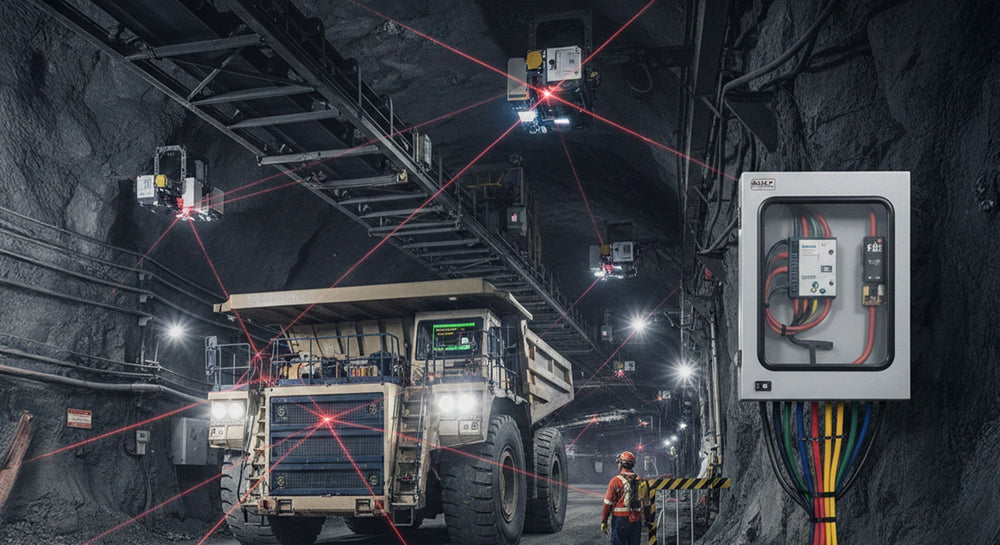
Mining operations face some of the most demanding safety and compliance requirements of any industry. From underground tunnels to open-pit excavation sites, equipment must perform reliably in harsh environments where failure is costly and dangerous. Laser sensors have become a cornerstone of modern mining safety systems, offering precision detection, real-time monitoring, and the kind of consistent performance that compliance frameworks demand.
For plant managers and procurement teams sourcing automation hardware for mining applications, understanding how laser sensors integrate into broader safety systems. and where to find reliable components is essential.
Why Laser Sensors Matter in Mining Safety
Modern mining safety systems are built around one core principle: detect hazards before they become incidents. Laser sensors support this goal across several critical applications:
- Proximity detection: Identifying personnel or equipment entering restricted zones around heavy machinery, conveyors, or blast areas
- Level and distance measurement: Monitoring stockpile levels, detecting bin overflow, and measuring material flow in processing plants
- Object detection on conveyors: Flagging blockages, misaligned materials, or foreign objects that could cause equipment damage or injury
- Vehicle and collision avoidance: Supporting automated and semi-automated haul truck systems with real-time spatial awareness
- Perimeter and access control: Securing hazardous zones in processing facilities and underground environments
Regulations from bodies such as the Mine Safety and Health Administration (MSHA) in the US and equivalent agencies in Australia, Canada, and the EU increasingly require documented, verified safety systems. Laser-based detection contributes to compliance by providing measurable, repeatable performance data that can be logged and audited.
Key Performance Parameters for Mining Environments
Not all laser sensors are suitable for mining. Dust, moisture, vibration, temperature extremes, and electromagnetic interference place strict demands on hardware selection. When evaluating laser sensors for mining safety applications, procurement and maintenance teams should prioritize:
- IP Rating: IP65 or higher ratings are common baselines for industrial and mining environments, with some applications requiring IP67 or IP68 for full water immersion protection
- Operating Temperature Range: Component operating ranges vary by manufacturer and product family; always verify against the specific sensor's datasheet for the temperature extremes present at your site
- Detection Range: Depending on the application, sensors may need reliable detection from a few centimeters up to several hundred meters
- Response Time: Safety-critical applications require fast response times, often measured in milliseconds
- Output Type: Discrete (PNP/NPN), analog (4–20mA or 0–10V), and IO-Link outputs each serve different integration scenarios
- Vibration and Shock Resistance: Essential for sensors mounted near conveyors, crushers, or mobile equipment
Manufacturers such as Sick, Pepperl+Fuchs, Banner Engineering, and Keyence produce laser sensor families specifically engineered for demanding industrial and mining-grade applications, with certified performance specifications to support compliance documentation.
Integrating Laser Sensors with Safety-Rated Control Systems
A laser sensor is only as effective as the safety system it connects to. In modern mining operations, laser sensors typically feed into:
- Safety PLCs: Controllers with SIL (Safety Integrity Level) ratings, such as those from Allen-Bradley, Siemens, or Pilz, process sensor inputs and trigger safety responses like E-stops or zone lockouts
- Safety Relays: For simpler safety circuits, dedicated safety relays provide a cost-effective interface between sensors and actuators.
- SCADA and DCS Systems: Supervisory systems aggregate sensor data for real-time monitoring, trend analysis, and compliance reporting
- Safety Scanners: Laser-based area scanners, such as the Sick S3000 series, create configurable safety zones without physical barriers
Meeting compliance under frameworks like IEC 62061 or ISO 13849 requires that the entire safety loop, from sensor to controller to actuator, achieves the required Performance Level (PL) or SIL rating. Hardware selection can't be made in isolation; each component must be verified as part of the complete safety architecture.
The Sourcing Challenge: Legacy and Hard-to-Find Safety Components
Mining operations often run equipment for decades. Older processing plants and underground installations may rely on safety systems built around sensor families or safety PLCs that are no longer in current production. When a critical sensor fails at a remote mine site, waiting weeks for standard manufacturer lead times isn't an option, as production stops and compliance obligations can lapse.
This is where independent suppliers play a valuable role. Access to surplus sealed, refurbished, and used components from established automation brands enables maintenance teams to source exact replacements without being forced into costly system overhauls. Surplus sealed components are factory-sealed units that may not be current production but are fully intact; a practical option for like-for-like replacements on legacy safety systems.
For procurement managers, working with an independent supplier that carries a broad automation inventory, including sensors, safety relays, PLCs, I/O modules, VFDs, and drives, simplifies sourcing across multiple safety system components from a single point of contact.
Compliance Documentation and Component Traceability
Regulatory compliance in mining isn't just about having the right hardware installed; it's about being able to prove it. Maintenance engineers and safety officers need:
- Original manufacturer specifications and datasheets
- Component condition transparency (surplus sealed vs. refurbished vs. used)
- Clear warranty coverage
- Traceability for audit purposes
When sourcing replacement safety components, these documentation requirements should factor into supplier selection. Reputable independent suppliers provide condition transparency and warranty coverage; PLC Direct backs all products with a 1-year warranty, giving maintenance teams confidence in the components they install and the records they maintain.
Keeping Mining Safety Systems Operational
Laser sensors and the safety systems they support are not a set-and-forget investment. Mining environments accelerate component wear, and proactive maintenance, including keeping critical spare sensors and safety controller components on hand, reduces the risk of unplanned downtime and compliance gaps.
For resellers supplying the mining sector and plant teams managing aging automation infrastructure, having a reliable source for both current and legacy sensor and safety hardware is a practical necessity. The combination of technical precision, environmental durability, and system-wide integration is what separates effective mining safety from checkbox compliance, and the right components are the foundation of it all.
Source Critical Mining Safety Components with Confidence
When a laser sensor or safety relay fails at a remote mine site, standard-channel lead times can halt production and create compliance gaps. PLC Direct stocks surplus sealed, refurbished, and used automation hardware from the brands your safety systems depend on: Sick, Siemens, Pilz, and more. Whether you're maintaining legacy safety infrastructure or sourcing hard-to-find replacements, PLC Direct provides condition-transparent components backed by a 1-year warranty. Contact us to check the availability of sensors, safety PLCs, relays, and I/O modules, so your operation stays compliant and running.
