
 1 year warranty

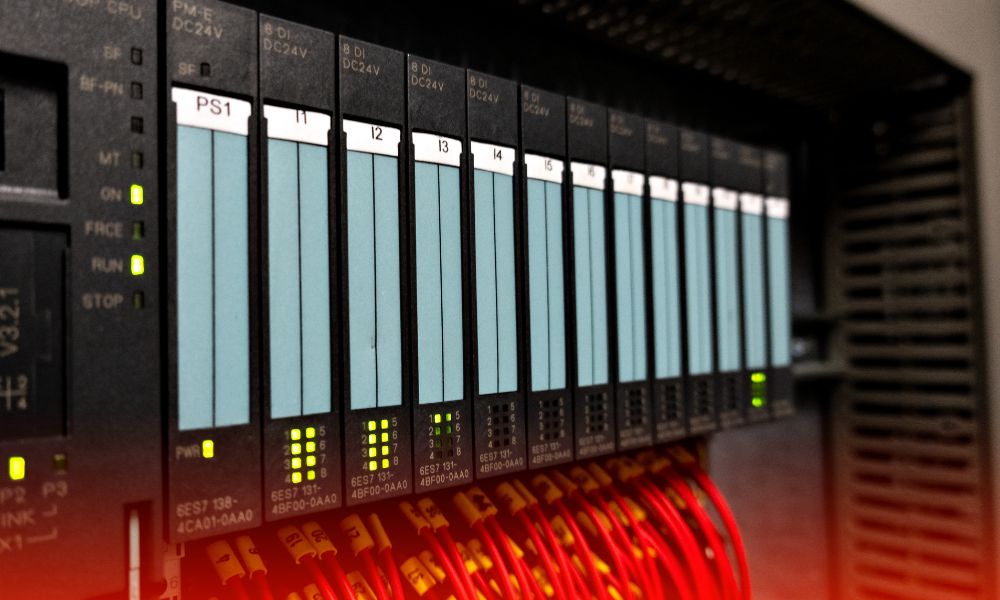
Modern warehouses operate as precision logistics environments where delays at any stage, whether sorting, conveying, packing, or dispatch, create downstream disruptions across the supply chain. As throughput demands increase and labor availability fluctuates, more warehouse operators are turning to programmable logic controllers to automate and stabilize their operations. Understanding how a PLC warehouse setup functions and what it delivers operationally is the starting point for any facility evaluating its automation options.
What Is a Warehouse Control System and Programmable Logic Control System?
A warehouse control system and programmable logic control system are related but distinct layers of warehouse automation. A warehouse control system (WCS) manages the real-time coordination of physical equipment, including conveyors, sorters, pick-and-place units, and barcode scanners. A PLC sits within or beneath that layer, executing the discrete logic commands that make individual machines operate: start, stop, sequence, interlock, and respond to sensor inputs.
In a typical warehouse, PLCs handle low-level machine control, while the WCS orchestrates the broader material flow. Together, they form the operational core of an automated facility. PLCs are well-suited to warehouse environments because they are designed for continuous duty in industrial conditions, offer deterministic scan-cycle execution, and can be programmed to respond to equipment faults or safety triggers without operator intervention.
How Do PLCs Improve Operational Efficiency in a Warehouse?
PLCs monitor and control various machines, equipment, and production lines simultaneously. In a warehouse, this means they can automate numerous devices, including material handling systems, conveyor belts, packers, and sorting equipment. By streamlining the processes that use these devices and removing human error, facilities can reduce the risk of downtime and delays and improve operational efficiency.
A PLC-controlled conveyor system, for example, can automatically adjust belt speed based on load sensor data, divert packages to the correct lane based on barcode reads, and trigger alerts if a jam is detected, all without requiring manual input at each step. This kind of closed-loop machine behavior is what makes PLC-driven automation particularly effective in high-throughput distribution environments.
What Are the Advantages of PLC Control System Implementation for Warehouse Safety?
Safety is a top priority in any warehouse. The advantages of PLC control system deployment extend directly to worker safety and equipment protection. PLCs can be programmed to automatically shut down equipment when a hazard is detected, when a safety gate is opened, or when a sensor detects an obstruction in a hazardous zone.
This functionality is not limited to emergency stops. PLCs can enforce speed limits on conveyor systems when workers are present in adjacent aisles, sequence interlocks to prevent two machines from operating in conflicting states, and monitor motor current to detect overload conditions before they cause equipment failure. Reducing both accident risk and unplanned equipment damage directly reduces the total cost of facility operations.
How Does Real-Time Monitoring Work in a PLC-Controlled Warehouse?
With PLCs, warehouse managers can remotely monitor operations, track inventory levels, and detect equipment malfunctions through digital sensors. Real-time monitoring allows managers to detect and respond to problems right away, which is beneficial for reducing downtime, tracking throughput, and maintaining inventory accuracy.
Modern PLC warehouse systems often integrate with SCADA or WCS software via industrial Ethernet or PROFIBUS, enabling supervisors to view equipment status, alarm history, and production data from a central workstation or a remote interface. This visibility gives maintenance engineers the diagnostic information they need to address faults before they result in full line stoppages.
How Do PLCs Increase Accuracy in Warehouse Operations?
Another benefit of implementing PLCs in warehouses is the enhanced accuracy they provide. PLCs regulate and dispatch commands to equipment, ensuring that every device performs each task exactly the same way. This is particularly important for repetitive tasks such as label verification, carton sealing, or pallet staging, where inconsistent execution can lead to downstream errors in order fulfillment.
By removing variability from machine operations, PLCs reduce mispicks, misroutes, and mislabels, which, in a high-volume facility, can yield meaningful cost savings and improvements in customer order accuracy.
Are PLCs a Cost-Effective Investment for Warehouse Automation?
The initial cost of implementing PLCs may appear significant. When measured against long-term operational savings, however, the return is substantial. PLCs can operate continuously with minimal maintenance requirements, support reduced staffing on automated lines, and lower the risk of unplanned equipment breakdowns that generate both repair costs and lost throughput.
Facilities that have moved repetitive manual processes onto PLC-controlled automation typically report reductions in labor cost per unit processed and improvements in equipment uptime. The modular architecture of most PLC platforms also means that capability can be added incrementally as facility needs change, without replacing the entire control infrastructure.
What Hardware Conditions Are Available for Warehouse PLC Systems?
For facilities sourcing PLC hardware for warehouse automation, components are typically available as surplus sealed, refurbished, or used. Surplus sealed units are factory-sealed stock that has not been put into service. Refurbished units have been tested, inspected, and restored to operational condition. Used hardware is drawn from decommissioned systems and is available for applications where budget is the primary constraint.
Each condition grade serves a different procurement need. A facility commissioning a new conveyor control system may prefer surplus sealed hardware for its installation. A maintenance team replacing a failed PLC on an existing line may find refurbished hardware the most practical option given availability and lead time.
PLC Direct stocks automation hardware across these condition grades from brands including Siemens, Schneider Electric, Omron, ABB, and more covering PLC platforms, I/O modules, VFDs for conveyor and motor control, and HMIs for operator interfaces. Warehouse automation decisions involve hardware choices that affect facility performance for years to come. To check availability on specific part numbers or discuss sourcing options, contact us.
