
 1 year warranty

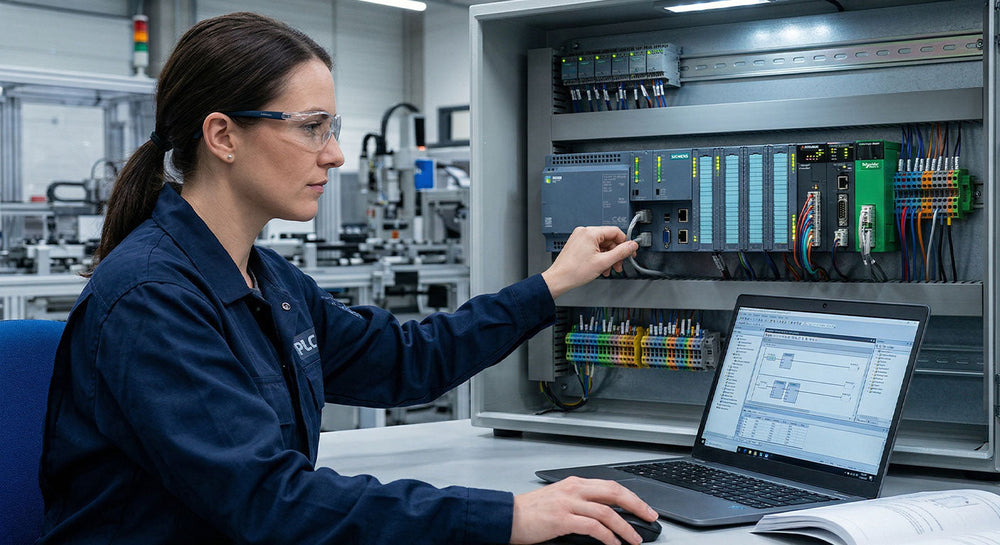
In industrial automation, no two facilities run identical processes or face the same equipment demands. A custom PLC, a programmable logic controller configured to match the specific requirements of an installed system, gives maintenance engineers and plant operators direct control over how automation functions, how safety is enforced, and how equipment performance is tracked. The PLC benefits and advantages of PLC customization covered below apply across manufacturing, processing, and utility environments where standard configurations fall short.
What Flexibility and Customization Advantages Does a Custom PLC Offer?
A custom PLC can be configured precisely to the I/O count, processing speed, memory, and communication protocols a facility requires, making it one of the most significant advantages of a PLC-based control architecture. You can program a customizable PLC to suit your facility and equipment, ensuring the automation system meets your unique requirements. You can select the number of inputs and outputs, memory, processing speed, and communication protocols. This level of customization also enhances flexibility in your workplace, making it easier to adapt to future advancements.
How Does Real-Time Monitoring Help Maintenance Teams Manage Equipment?
Customizable PLCs provide real-time monitoring, enabling maintenance teams to detect and address faults before they cause unplanned downtime. Customizable PLCs enable real-time monitoring of activities in your facility, allowing you to detect and resolve issues immediately. With these systems, you can track various parameters, such as machine performance, production rates, energy consumption, and maintenance needs. You can even access this information remotely, allowing you to monitor progress and make decisions from anywhere. This way, you're never left out of the loop when it comes to managing your equipment and its overall performance.
What Safety Features Do Customizable PLCs Provide for Industrial Operations?
Customizable PLCs include built-in safety features that can be configured to the specific hazard profile of an installation, making safety one of the most operationally important benefits of these systems. Customizable PLCs feature built-in safety features that protect your employees and equipment. With systems such as emergency stops, interlocks, and built-in safety relays, it's possible to minimize the risks of accidents and reduce the chances of equipment failure. The more safety measures you put into effect now, the better off your team and your company will be.
How Do Custom PLCs Reduce Downtime and Maintenance Costs?
A custom PLC reduces downtime by detecting and diagnosing faults before they cause equipment failure, giving maintenance teams the information they need to act before a line stops. Additionally, customizable PLCs can detect and diagnose faults in your system, preventing equipment failure and reducing downtime. By monitoring equipment condition and providing real-time information on maintenance needs, you can schedule timely maintenance when needed. This will keep your machines performing better in the long term and reduce the frequency and duration of downtime.
Which Industries Rely on Custom PLC Configurations?
The advantages of PLC customization apply across industrial sectors but are most significant where processes are highly specific, environments are demanding, or equipment lifecycles are long. Manufacturing operations with non-standard machine configurations, mineral processing plants with multi-stage control requirements, and utilities managing distributed pump and valve networks all depend on custom PLC programming to meet process demands that standard configurations cannot address. VFDs, I/O modules, HMIs, and sensors all interact directly with PLC control logic, and the ability to tailor a custom PLC configuration to the full system architecture is what keeps the automation layer functional across mixed equipment generations.
Conclusion
PLC Direct supplies surplus sealed, refurbished, and used PLC hardware and automation components across leading brands, including Siemens, ABB, and Omron. Whether you are replacing a controller in an existing custom PLC installation or sourcing components to extend the life of an aging system, availability across multiple product families means you are not limited to a single sourcing channel. All hardware comes with a 1-year PLC Direct warranty. Contact PLC Direct to check availability of the components your installation requires.
