
 1 year warranty

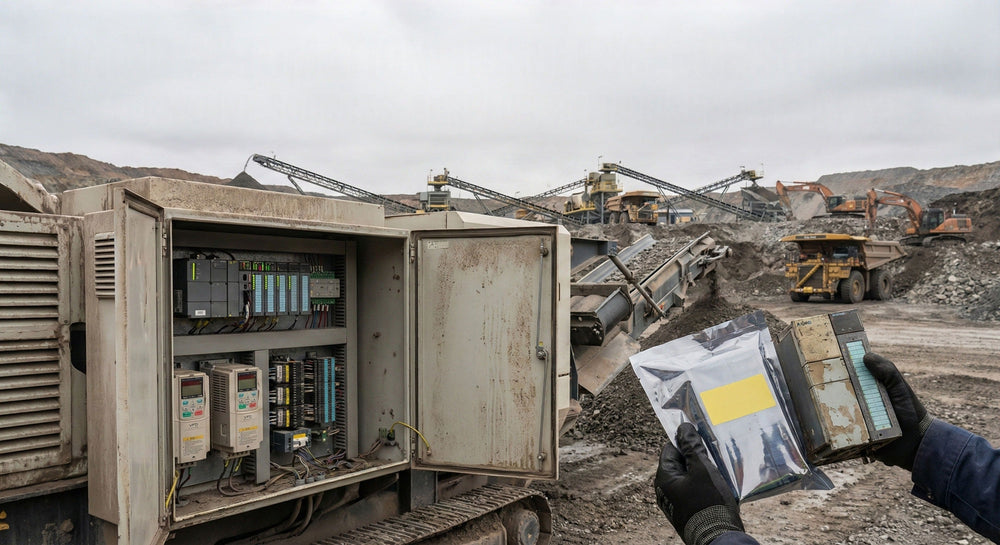
Mining operations run on tight margins and tighter schedules. When a manufacturer discontinues support for a critical automation component, a PLC, VFD, HMI, or I/O module, the operational fallout can be immediate and costly. According to ABB's Value of Reliability survey (2023), which gathered responses from 3,215 plant maintenance decision-makers globally, unplanned downtime costs the typical industrial business close to $125,000 per hour (global median). For mines, where equipment failure can cascade across entire extraction and processing lines, the stakes are even higher.
Understanding where to source discontinued or hard-to-find industrial automation parts, and how to evaluate the repair-or-replace decision is increasingly essential for procurement managers and maintenance engineers in the mining sector.
How Common Is Automation Component Obsolescence in Mining?
Component obsolescence is not an edge case. It is a structural reality of industrial automation.
Many mines operate equipment with lifecycles measured in decades. PLCs, VFDs, motor control systems, and HMIs installed during initial commissioning may be running on platforms manufacturers discontinued years ago. When those systems need a replacement part, the OEM is no longer an option.
The scale of the problem is significant. The global mining automation market was valued at USD 3.5 billion in 2023 and is projected to grow at a CAGR of over 8% through 2032. That growth means a continuously expanding installed base of automation hardware, all of which will eventually face the same obsolescence cycle.
Should You Repair or Replace Discontinued Automation and Control Parts?
When a critical component fails or approaches the end of its life, the decision comes down to two options: repair the existing unit or source a replacement. Both have merits depending on the situation.
When repair makes sense
Repair is often the faster, lower-cost option when the failure is isolated: a blown component, damaged connector, or failed power supply within an otherwise functional unit. It also preserves system compatibility, which matters when substituting a newer model would require reprogramming or I/O rewiring.
For remote mine sites with extended shipping lead times and limited on-site engineering resources, a repaired unit back in service is often the more practical outcome.
When replacement makes sense
Replacement becomes the stronger choice when a unit has failed multiple times, when repair costs approach the cost of a replacement, or when a warrantied, surplus, sealed, or refurbished unit is readily available.
The math shifts quickly at the mining scale. A single downtime incident averages approximately $180,000 in losses. At that cost, the premium for a quality replacement with warranty coverage is often negligible.
What Are the Alternative Sources for Mining Automation Parts?
When OEM support ends, three sourcing options cover most scenarios.
- Surplus sealed units are factory-sealed and never installed, though they may be older stock. They retain original manufacturer specifications and are ideal for exact-model replacement of discontinued parts.
- Refurbished units have been previously used, then inspected, tested, and restored to operational condition in accordance with manufacturer specifications.
- Used components are pulled from decommissioned equipment or excess inventory. They work well for facilities with in-house testing capability and the technical staff to verify the condition before installation.
The most reliable independent suppliers carry all three condition categories across a full range of automation hardware, PLCs, VFDs, drives, motors, HMIs, sensors, and I/O modules, with clear condition labeling and warranty coverage on every sale.
Is the Obsolescence Problem Limited to PLCs?
Mining sites run on a broad automation ecosystem, and discontinuity affects every layer of it.
VFDs and motor drives control conveyor systems, crushers, ventilation fans, and pumps. A discontinued VFD often requires matching not just electrical specs but also communication protocols and control wiring. These factors make exact model sourcing far preferable to substituting a newer-generation unit.
HMIs present similar challenges. A discontinued operator panel integrated with years of configured process visualization software can require extensive reconfiguration if replaced with a current-generation unit. Surplus sealed or refurbished alternatives sidestep that entirely.
I/O modules, sensors, and precision instruments round out the picture. Discontinued analog input cards, digital output modules, and field sensors create sourcing bottlenecks that directly translate into extended equipment downtime.
What Should Mining Teams Look for in an Independent Automation Parts Supplier?
Not all independent suppliers are equal. When evaluating options, these are the criteria that matter most for mining operations.
- Full ecosystem inventory: PLCs, VFDs, drives, motors, HMIs, sensors, and I/O modules, not just one or two component types
- Clear condition labeling: Surplus sealed, refurbished, and used accurately described and distinguished
- Warranty coverage: A 1-year warranty is a reasonable baseline and a reliable indicator of supplier confidence in product condition
- Legacy inventory depth: Genuine capability to source discontinued models, not just current-generation parts
- Lead time reliability: When downtime costs are measured in hours, fulfillment speed is an operational variable, not a logistics preference
How Do Independent Suppliers Differ from Authorized Distributors?
Authorized distributors are limited to current, active product lines. When a manufacturer discontinues a product, it leaves authorized channels entirely, leaving procurement teams with no OEM-sanctioned source.
Independent suppliers operate without those restrictions. They source surplus sealed, refurbished, and used inventory across both active and discontinued product families. For mining teams managing aging automation infrastructure, independence is often the only path to keeping systems operational.
PLC Direct carries surplus sealed, refurbished, and used industrial automation hardware, including VFDs, drives, motors, HMIs, sensors, I/O modules, and PLCs, all backed by a 1-year warranty. Contact us to access our available inventory or discuss specific part requirements.
