
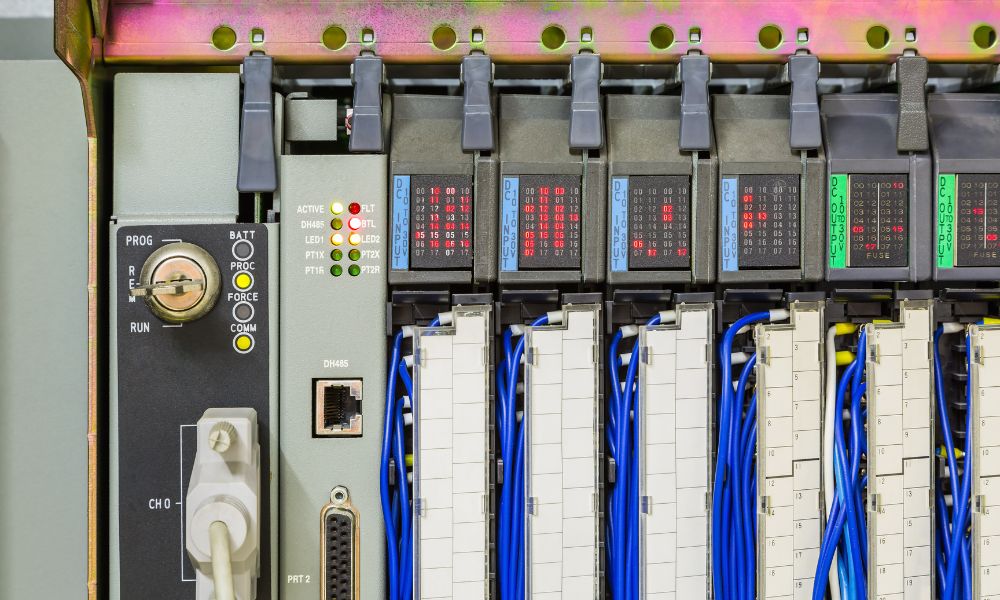
Programmable logic controllers (PLCs) are a foundational part of modern industrial automation, and understanding their internal architecture is essential for anyone involved in specifying, maintaining, or sourcing this equipment. Whether you are evaluating a replacement unit or troubleshooting a fault in an existing installation, knowing the major components of a PLC and what each one does helps you make faster, more accurate decisions. Here is a breakdown of PLC components and their functions.
What Does the Central Processing Unit (CPU) Do in a PLC?
A central processing unit is the brain of the PLC, managing all the input and output signals. It takes instructions from the user program and translates them into actions that the other components can execute in real time. The CPU also stores the user program and performs diagnostics to ensure the PLC is operating correctly. CPU performance and speed are critical factors in a PLC's overall performance.
What Does the Input/Output (I/O) System Do?
The I/O system connects sensors, switches, and other input devices to the PLC. The inputs can come from a variety of sources, such as temperature sensors, proximity switches, and pressure transducers. The I/O system converts the physical signals into digital signals that the CPU can recognize. Similarly, the I/O system sends output signals to other devices, such as motors and valves.
I/O modules are generally categorized as discrete or analog:
-
Discrete I/O handles on/off signals, a limit switch that is open or closed, a motor that is running or stopped.
-
Analog I/O handles continuous signals, such as a 4–20 mA current loop from a pressure transmitter or a 0–10 V signal from a speed reference.
In modular PLC systems, I/O cards can be added or replaced individually, making I/O point count and module type among the most important specifications when sourcing replacement hardware for an existing installation.
What Role Does Memory Play in a PLC System?
A PLC uses different types of memory to store different types of information. The CPU uses read-only memory (ROM) to store the user program, which contains the instructions for the PLC’s operation. Random-access memory (RAM) stores data temporarily during the program’s execution, allowing the CPU to access critical data quickly. Electrically Erasable Programmable Read-Only Memory (EEPROM) aids in managing information that you, as the user, can change or erase as needed. This includes setpoints and configuration data.
What Does the Power Supply Do in a PLC?
A PLC system requires stable and reliable power to operate correctly. The power supply converts the incoming AC or DC power to the appropriate voltage level needed by the different components. Most PLC systems have built-in redundancies, where a secondary power supply can take over if the primary one fails.
When sourcing a replacement power supply for an existing PLC installation, the input voltage range, output voltage, and current rating must match the original unit's specifications. A mismatch in any of these, even if the module physically fits the rack, can cause erratic system behavior or hardware damage. Always cross-reference the part number against the original installation documentation before ordering.
What Is the Programming Environment in a PLC?
Another important PLC component to know and understand is the programming environment. This is where users create and edit the PLC program. Program writing occurs in a specialized language called ladder logic, which uses symbols and diagrams to represent logical instructions. Modern PLCs come with user-friendly software that allows users to program the system easily.
Ladder logic is the most widely used PLC programming language, but it is one of five languages defined under the IEC 61131-3 international standard. The others, function block diagram (FBD), structured text (ST), instruction list (IL), and sequential function chart (SFC), are supported on most modern PLC platforms and are worth knowing for maintenance engineers who work across different systems. Programming environments are manufacturer-specific, so a program written for one platform cannot typically be transferred to another without modification.
To Conclude
These essential components of a PLC work together to provide accurate and reliable control of industrial processes. Understanding how each component works can help you make informed decisions about PLC implementation and identify areas of improvement in your manufacturing operations. At PLC Direct, we carry hundreds of models for you to choose from, including our popular collection of Siemens PLCs, B&R, Omron, and more. Regardless of your desired specifications, we’re confident we have something that will work for you.
PLC Direct supplies surplus sealed, refurbished, and used PLC hardware across a wide range of platforms, including Siemens SIMATIC, Omron Sysmac, Mitsubishi Electric MELSEC, Schneider Electric Modicon, B&R, and more. All products ship free worldwide and include a 1-year PLC Direct warranty. Contact us to check availability on the components you need.
