
 1 year warranty

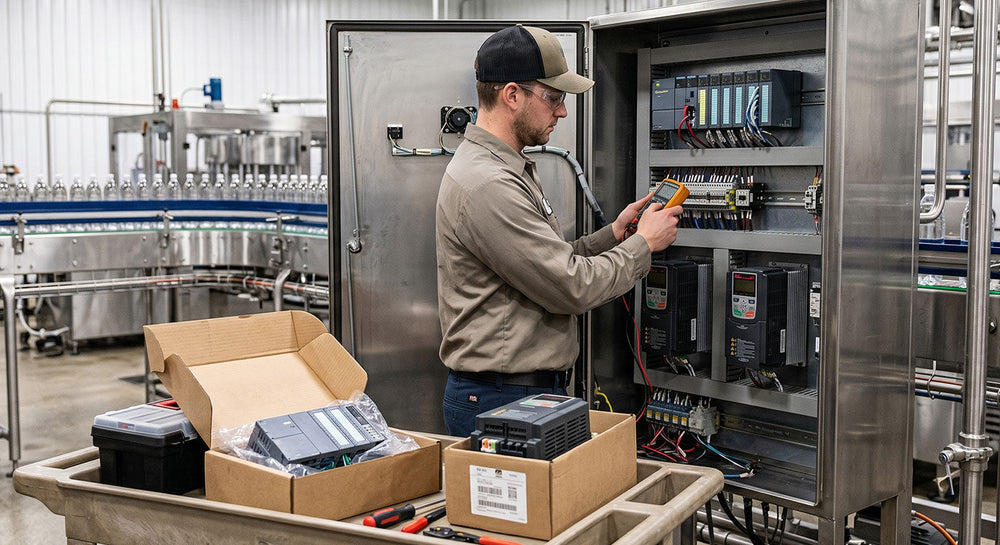
According to the U.S. Department of Commerce Census Bureau's County Business Patterns, as reported by the USDA Economic Research Service, there were 42,708 food and beverage manufacturing establishments operating across the United States in 2022.
Every one of those facilities depends on automation parts food and beverage industry to keep production lines running, and when that hardware fails, sourcing a compatible replacement quickly becomes the only priority.
For maintenance engineers on food and beverage lines, finding the right surplus PLC for food processing or replacing a failed VFD food manufacturing line is not a theoretical exercise. It is an operational decision made under time pressure, often against long OEM lead times and tight capital budgets. This guide covers the hardware categories that matter most, the environmental factors that drive failure, and where to look when standard supply channels fall short.
What Automation Parts Do Food and Beverage Industry Processing Lines Depend On?
Food and beverage processing lines depend on several distinct automation hardware categories, each with its own failure profile and sourcing complexity.
What Role Do PLCs and PACs Play on Food and Beverage Processing Lines?
PLCs and PACs manage batch control, recipe management, conveyor sequencing, and safety interlocks. Schneider Electric Modicon M340 and M580 controllers are widely deployed in food and beverage facilities, as are Siemens SIMATIC S7-300 and S7-400 systems, both now in the legacy phase of their lifecycle with tightening OEM parts availability. Omron Sysmac NX series and Mitsubishi Electric MELSEC FX5 and Q Series PLCs are also common on packaging and processing lines.
Why Are VFDs Among the Most Maintenance-Intensive Components on a Food Production Line?
VFDs are among the most maintenance-intensive components on a food production line, controlling motor speed on mixers, conveyors, filling heads, pumps, and CIP systems. Schneider Electric Altivar 61 drives are designed for pump and fan applications, relevant to CIP and fluid transfer. Siemens SINAMICS drives cover a broad range of motor control applications across production environments.
What Do HMIs Handle on Food and Beverage Processing Equipment?
HMIs handle recipe selection, batch monitoring, and fault acknowledgment at the operator level. Mitsubishi Electric GOT2000 and GOT Simple panels, as well as Siemens SIMATIC HMI operator panels, are regularly installed on food and beverage packaging and processing equipment.
What Do Sensors and I/O Modules Control on a Food Processing Line?
Sensors and I/O Modules manage fill level detection, temperature and pressure monitoring, product presence sensing, and conveyor positioning. Siemens SITRANS instrumentation is commonly used for process measurement in food and beverage applications. Omron CJ Series I/O modules provide modular expansion for CJ-platform installations.
Why Do Food and Beverage Environments Cause Accelerated Automation Hardware Wear?
Food and beverage environments degrade automation hardware faster than general manufacturing environments due to three compounding factors: washdown exposure, temperature cycling, and airborne contamination.
Washdown cycles introduce moisture into enclosures, terminal strips, and fan-cooled drive assemblies. High-pressure cleaning with chemical sanitizers is standard in food processing, and any enclosure seal that is not properly maintained becomes a point of failure. VFDs and PLCs with inadequate IP ratings are particularly vulnerable.
Temperature cycling between cold storage, ambient production, and heated processing zones repeatedly subjects circuit boards, connectors, and capacitors to thermal stress. Capacitor degradation in VFDs is a direct consequence and a leading cause of drive failure on food manufacturing lines.
Airborne flour, sugar dust, and oil mist accumulate on cooling fins and fan blades, reducing thermal performance until shutdowns or component failures occur. These failure modes are predictable, but replacement logistics are not always straightforward; legacy PLCs and older VFD models may no longer be available through standard OEM channels, with lead times stretching to weeks.
How Does Sourcing Surplus Automation Parts for the Food and Beverage Industry Work?
Sourcing surplus automation parts for the food and beverage industry is driven by one requirement: compatibility with existing installations.
A refurbished Modicon M340 CPU that matches the existing rack and I/O configuration restores a line without requiring a controls engineer to re-commission from scratch. A surplus sealed Altivar 61 drive in the correct frame size slots directly into an existing panel. In both cases, the sourcing decision is about restoring operation, not upgrading it.
PLC Direct supplies surplus sealed, refurbished, and used automation hardware across the brands deployed in food and beverage processing, including legacy Siemens S7-300 and S7-400 hardware, Modicon Quantum and Premium platforms still running in older facilities, and earlier-generation Altivar and SINAMICS drive series. All products carry a 1-year PLC Direct warranty.
What Should Maintenance Engineers Verify Before Replacing a VFD on a Food Manufacturing Line?
Before replacing a VFD on a food manufacturing line, confirm the power ratings, physical fit, control wiring, and communication interface of the replacement unit.
Input voltage, output current rating, and motor kW or HP must match the installed drive. Frame size determines whether the replacement fits without panel modification. Control wiring connections, including analog inputs, digital I/O, and communication ports, must align with the existing configuration. For Altivar 61 drives on pump applications, confirming the communication card variant, Modbus, PROFIBUS, or EtherNet/IP, avoids additional engineering work during swap-out. For Siemens SINAMICS drives, the Control Unit and Power Module may need to be matched separately, and firmware version gaps between installed and replacement units can complicate parameter transfer.
Which Brands Are Most Commonly Sourced for Food and Beverage Automation Maintenance?
The brands most frequently sourced for food and beverage automation maintenance reflect the installed base across the industry, not current product catalogs.
-
Siemens SIMATIC S7-300 and S7-400 PLCs, SINAMICS drives, SIMATIC HMI panels, and SITRANS instrumentation are found across legacy and more recent food and beverage installations. As the S7-300 and S7-400 platforms move toward end-of-life manufacturer support, maintenance engineers are increasingly sourcing replacement hardware through independent suppliers to avoid OEM lead time exposure.
-
Schneider Electric Modicon M340 and M580 PACs are deployed across beverage, dairy, and packaged food facilities. The Altivar 61 VFD series remains a standard for pump and fan control across food processing plants. Older Modicon Quantum and Premium installations continue to run in bulk food processing facilities built in the 1990s and 2000s.
-
Omron Sysmac NX series and CJ Series hardware are widely used on packaging lines and food processing equipment where compact machine-level control and modular I/O are the requirements.
-
Mitsubishi Electric MELSEC FX5 and Q Series PLCs, along with GOT2000 HMIs, are installed across food processing and packaging equipment throughout the industry.
PLC Direct supplies surplus PLC food processing, refurbished, and used automation hardware across the brands and product families deployed throughout the food and beverage industry. Contact us to check availability on specific part numbers and request a quote.
