
 1 year warranty

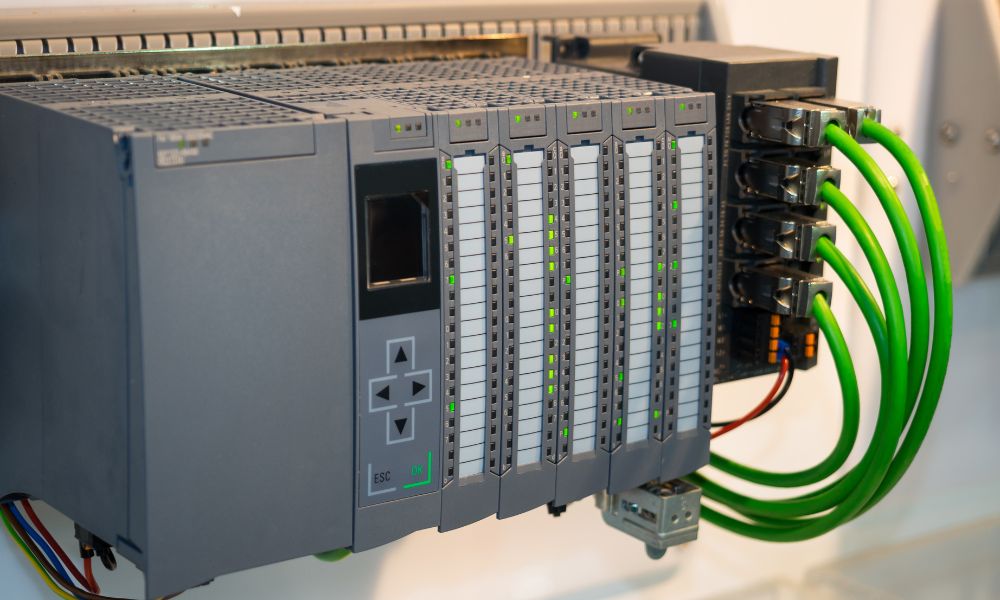
Unplanned equipment downtime is one of the most disruptive forces in manufacturing. A single failed control component can stall an entire production line, delay order fulfillment, and create ripple effects that take days or weeks to resolve. Understanding how PLCs integrate into the broader automation layer of a facility explains why they remain central to supply chain productivity in manufacturing environments of every scale. The role of the PLC supply chain relationship extends well beyond basic machine control. It reaches into communication architecture, fault detection, and throughput consistency across every stage of production.
How Does a PLC Improve Order Flow on a Manufacturing Line?
For machines to run according to production schedules, there needs to be a reliable system for delivering operational instructions. Manually sending commands to individual pieces of equipment is time-consuming and introduces human error at every step. PLCs function as centralized control units that issue commands to multiple machines simultaneously, removing the bottleneck of manual sequencing and allowing lines to respond to production changes quickly.
This matters most in high-mix environments where production orders shift frequently. A SIMATIC S7-300 or S7-400 controller managing a multi-station assembly line, for example, can coordinate machine states across the entire cell based on a single updated recipe or batch parameter, reducing changeover time and keeping throughput consistent.
How Do PLCs Enable Machine-to-Machine Communication Across a Production System?
Modern manufacturing lines rarely operate as isolated machines. Conveyors feed press stations, which feed assembly cells, which feed inspection and packaging. Each transition depends on data passing accurately between control systems. PLCs both send and receive process data, creating a closed-loop communication structure that keeps each machine informed of upstream and downstream conditions in near-real time.
This communication architecture becomes especially important when variable frequency drives (VFDs) are involved. In applications where conveyor speed, pump flow rate, or motor torque must be adjusted based on upstream conditions, the PLC serves as the decision layer, interpreting sensor inputs and signaling the VFD to respond accordingly. Schneider Electric Altivar drives, for instance, are commonly paired with Modicon PLCs in this kind of coordinated motion and flow-control setup. The quality of that integration depends entirely on how well the control hardware communicates, and PLCs are the component that enables that coordination.
How Does PLC in Supply Chain Management Help Identify Equipment Problems Before They Cause Downtime?
PLC in supply chain management contributes most visibly when something goes wrong, and more importantly, before something goes wrong entirely. Modern PLCs continuously monitor input signals from sensors, encoders, pressure transducers, and other field devices. When a reading drifts outside defined parameters, the controller flags the condition before it escalates to a fault that stops the line.
Predictive and early-warning diagnostics reduce unplanned downtime, which directly affects order fulfillment timelines and production costs. A maintenance team that can respond to a flagged condition during a scheduled window avoids the far more expensive scenario of an emergency shutdown mid-shift. HMIs connected to the PLC layer make diagnostic information visible to operators at the machine level, while instrumentation, flow meters, temperature transmitters, and pressure sensors feed raw data that enables early detection. PLCs do not function in isolation; they are the processing layer that makes the broader automation ecosystem useful.
How Do PLCs Maximize Throughput and Reduce Idle Time in a Manufacturing Environment?
Idle time in manufacturing has a direct cost. Machines waiting for instructions, operators manually resetting sequences, or lines pausing between batches all represent lost production capacity. PLCs minimize these gaps by automating the sequencing logic that would otherwise require manual intervention at each stage.
When a production system is properly configured, machines transition from one operational state to the next based on conditions, such as a sensor confirming a part is in position, a timer completing a cycle, or a VFD signaling that a motor has reached target speed, rather than waiting for an operator to issue the next command. The result is more consistent throughput, better utilization of available shift time, and a production operation that responds to schedule demands predictably.
Servo drives also play a role here in precision manufacturing contexts. In applications requiring exact positioning, CNC-adjacent assembly, labeling, or cut-to-length operations, servo drive systems operating under PLC control deliver the repeatability that keeps yield rates high and scrap rates low. Mitsubishi Electric MELSEC controllers, for example, are widely deployed in precisely these kinds of discrete manufacturing setups, where cycle-time consistency is essential.
What Should Procurement and Maintenance Teams Know About Sourcing PLC Hardware for Supply Chain Systems?
Supply chain disruptions affect automation hardware as much as any other industrial commodity. When a PLC, I/O module, or associated control component fails in a production-critical application, the sourcing path matters as much as the part itself. OEM lead times on current-production PLCs can stretch weeks, and legacy controllers that anchor older installed systems may no longer be available through standard channels at all.
PLC Direct is an independent supplier of surplus sealed, refurbished, and used industrial automation hardware. The inventory spans PLCs, VFDs, servo drives, HMIs, I/O modules, instrumentation, and power supplies across brands including Siemens, Schneider Electric, Mitsubishi Electric, ABB, and Omron. For facilities maintaining installed automation systems, particularly those running legacy Modicon Quantum, SIMATIC S7-300/S7-400, or MELSEC Q Series platforms, PLC Direct provides access to hardware outside standard OEM distribution timelines.
All products carry a 1-year PLC Direct warranty. We supply hardware only and do not provide programming, integration, or technical support services. Looking for surplus sealed or refurbished PLC hardware to support your production operation? Contact us to check availability and request a quote.
