
 1 year warranty

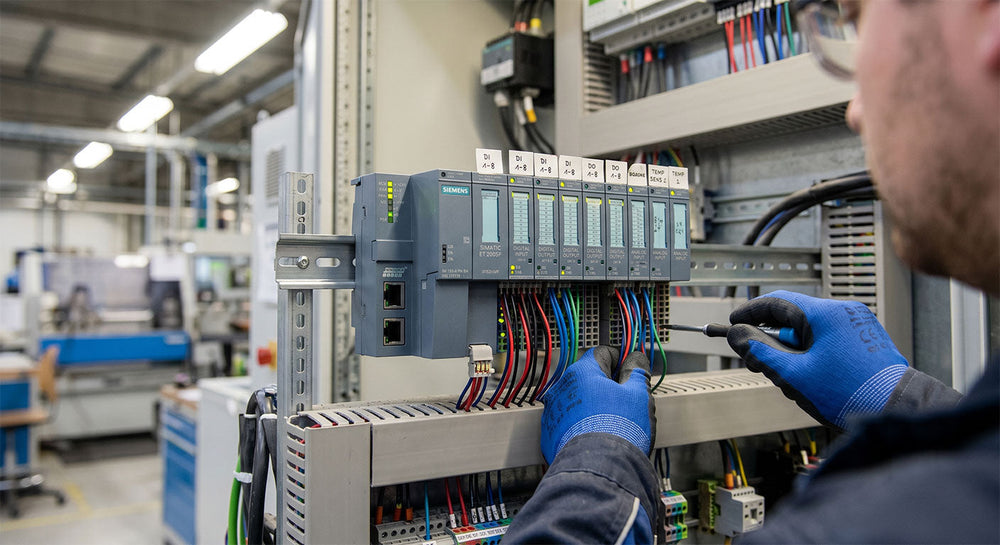
When a control system needs to read sensors and drive actuators at multiple points across a large facility, running individual signal cables back to a central cabinet quickly becomes impractical. Distributed I/O modules solve this by placing input and output hardware close to the field devices they serve, connecting back to the central controller over a fieldbus network rather than through individual wiring runs. The result is a leaner installation, faster signal response, and a system architecture that is significantly easier to extend or modify.
For maintenance and procurement teams, distributed I/O modules are among the most frequently replaced components in an automation system. They sit at the boundary between the control system and the physical process, which exposes them to vibration, heat, moisture, and electrical interference more directly than hardware mounted in a protected cabinet. Sourcing a like-for-like replacement quickly is often the difference between a brief maintenance intervention and an extended line stoppage.
What Are Distributed I/O Modules and How Do They Work?
Distributed I/O modules are hardware units that connect field devices, including sensors, switches, actuators, and drives, to a PLC or DCS over a digital communication network. Each module handles a defined set of input or output channels, converting field signals into digital data the controller can process, or translating controller commands into output signals that drive field devices.
A typical distributed I/O station consists of:
-
A communication interface module that manages the fieldbus connection
-
Digital input and output modules handling discrete field signals
-
Analog input and output modules for process variables such as temperature, pressure, and flow
-
A server or termination module that closes the station configuration
The interface module communicates with the central controller via PROFIBUS, PROFINET, EtherNet/IP, EtherCAT, or DeviceNet, depending on the platform in use. Individual I/O modules plug into the station and can typically be added or removed without taking the entire station offline, simplifying maintenance and expansion.
The key advantage of this architecture is that field wiring stays local. A remote I/O station installed near a pump skid or conveyor drive handles all the signals from that area, sending only network data back to the controller. This significantly reduces total cable runs and makes fault isolation easier when a signal problem develops.
Which Distributed I/O Platforms Are Most Common in Industrial Installations?
Several major automation platforms have well-established distributed I/O architectures, and the hardware that needs replacing in an existing installation will typically be part of one of them. Understanding which platform is in use determines which replacement hardware is compatible.
Siemens SIMATIC ET 200SP is one of the most widely deployed distributed I/O systems in process and manufacturing environments. ET 200SP stations communicate via PROFINET and support a broad range of digital and analog I/O modules, motor starters, and safety-rated modules. The system supports hot-swapping of individual modules, allowing replacements without powering down the entire station.
Omron CJ Series I/O modules are widely used in CJ1 and CJ2-based installations across manufacturing and process applications. The CJ1W module range covers:
-
Digital input units: CJ1W-ID211
-
Digital output units: CJ1W-OD211, CJ1W-OC211
-
Analog I/O units: CJ1W-MAD42
-
Communication modules: CJ1W-EIP21 for EtherNet/IP connectivity
Omron's Sysmac NX platform uses a separate I/O architecture over EtherCAT, with NX I/O modules and EtherCAT couplers handling field connectivity in newer installations.
Schneider Electric Modicon Momentum is a distributed I/O platform built around modular I/O bases and snap-on communication adapters. Momentum modules are widely installed in process industries and light manufacturing, communicating over Modbus Plus, PROFIBUS, and Ethernet, depending on the adapter fitted. For installations running Modicon M340 or M580 PACs, the X80 I/O module range provides the standard distributed I/O interface across both controller platforms.
ABB S500 I/O modules are the standard I/O expansion hardware for the AC500 PLC family, supporting digital and analog I/O for process and machine control applications.
What Makes Remote I/O Replacement More Complex Than Local I/O?
Remote I/O replacement requires matching more parameters than simply finding a module with the same channel count. The replacement must be compatible with the specific communication protocol and fieldbus address configuration of the installed station, and in many cases must match the exact firmware version or hardware revision to avoid conflicts with the existing system configuration.
In PROFIBUS and PROFINET installations, the GSD or GSDML device description file associated with the installed module determines how the controller recognizes it. Swapping in a different module variant, even one with similar I/O characteristics, can cause the controller to flag a hardware mismatch and refuse to initialize the station. This is why exact part number matching is the most reliable approach for remote I/O replacement in an existing system.
Two additional factors to verify before ordering:
-
IP rating and environmental variants: Modules installed outside protected cabinets, or near high-vibration machinery or chemical exposure, may require specific ingress protection ratings or conformal coating variants.
-
Hardware revision: Some module families have multiple hardware revisions under the same base part number, with differences that affect firmware compatibility.
How Do You Source Surplus I/O Modules for Industrial Automation Systems?
Sourcing starts with identifying the exact part number of the installed module. Distributed I/O hardware carries part numbers that encode the module type, channel configuration, signal range, and, in some cases, the hardware revision. Using this as the basis for sourcing avoids the compatibility issues that arise from substituting a similar but not identical module.
Condition options available through independent suppliers:
-
Surplus sealed: Factory-sealed stock carrying the original hardware specification. Installs directly as a like-for-like replacement in most cases
-
Refurbished: Tested and restored to operational condition, providing an option when surplus sealed units are unavailable
-
Used: Verified for functionality, suitable where application criticality and maintenance standards permit
PLC Direct stocks surplus I/O modules for industrial automation platforms, including Siemens SIMATIC ET 200SP, Omron CJ Series and Sysmac NX, Schneider Electric Modicon Momentum and X80, and ABB S500. All products carry a 1-year PLC Direct warranty.
For facilities managing legacy installations with discontinued I/O hardware, independent suppliers with broad stock depth across multiple product generations are often the most practical sourcing route. OEM availability for older distributed I/O modules can be limited or discontinued entirely, and standard distribution channels typically carry only current product lines. Surplus I/O modules for industrial automation systems that have been in service for 10 or more years are often only available from independent suppliers who actively stock legacy hardware.
If you are sourcing distributed I/O modules or need replacement hardware for an existing automation installation, get in touch with us to check current availability and request a quote.
