
 1 year warranty

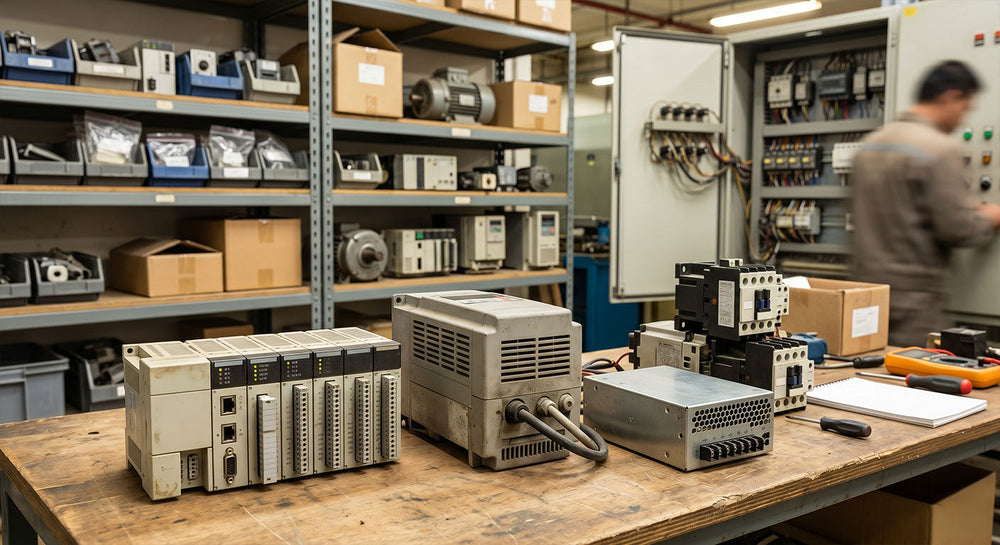
When an aging automation system goes down, the bottleneck is rarely the repair itself. It's the part. Control panel hardware that was specified fifteen or twenty years ago sits outside current OEM production cycles, lead times stretch into weeks, and the installed base keeps running until the day it doesn't. A reactive sourcing approach makes that gap expensive. A planned spare parts strategy closes it.
This guide covers how maintenance and procurement teams can build a more reliable supply chain for aging industrial automation hardware, from power supplies and switchgear to PLCs, drives, and I/O, before a failure forces the issue.
Why Do Aging Automation Systems Create Sourcing Problems?
Industrial control systems are built to last. A Siemens SIMATIC S7-300, a Schneider Electric Modicon Quantum, or an ABB AC500 installed in the early 2000s may still be running production-critical processes today. That longevity is an asset. The sourcing challenge it creates is not.
Manufacturers eventually discontinue product families or shift production to newer platforms. Authorized distribution channels thin out as demand for legacy hardware drops. The components still in service, including SITOP power supplies, SIRIUS motor starters, Altivar drives, and legacy I/O modules, are increasingly difficult to source through standard channels, even though they remain essential to operations.
For maintenance engineers managing installed-base systems, this means two things: lead times for OEM replacements get longer, and the risk of unplanned downtime increases. A spare parts strategy built around confirmed availability rather than assumed availability addresses both.
What Industrial Control Panel Hardware Should Be on Your Spare Parts List?
Not every component in a control panel carries the same downtime risk. Spare parts planning works best when it's prioritized by failure consequence, not just failure probability.
The components most worth stocking for aging systems include:
Power Supplies
A failed power supply takes down everything downstream of it. Surplus sealed SITOP power supplies are a practical stocking choice for Siemens-based panels; equivalent units from other confirmed vendors serve the same role in mixed-brand installations. Power supplies are relatively compact, have well-defined input/output specs that make cross-referencing straightforward, and are among the most consequential single points of failure in any control panel.
PLCs and CPU Modules
Legacy CPU units from platforms like the Modicon M340, MELSEC Q Series, Sysmac CJ Series, and SIMATIC S7-300/S7-400 are no longer in active production in many configurations. A refurbished spare on the shelf is categorically different from a six-week OEM lead time when a line is down.
VFDs and Drives
Variable frequency drives in conveyor, pump, and fan applications operate continuously and are among the higher-wear components in any automation system. Altivar 61 and 71 units, ABB ACS series drives, and SINAMICS drives are all worth evaluating for spare stocking, depending on what's installed.
I/O Modules
Individual I/O cards are often the first components to fail in older systems due to age, vibration, or heat cycling. They're also frequently discontinued ahead of the CPUs they connect to. Stocking one or two of each module type actively in use costs far less than a production stop while sourcing a replacement.
Switchgear and Motor Starters
Refurbished switchgear automation components, including contactors and motor protection devices, should be included in any spare parts plan for facilities running older motor control centers. SIRIUS switching devices and comparable hardware from other confirmed brands carry long service lives but are not immune to contact wear or coil failure.
How Do You Prioritize Which Spare Parts to Stock?
A practical prioritization framework uses three variables: criticality, lead time, and failure history.
-
Criticality: What stops if this component fails? A PLC controlling a primary production line has a higher criticality than a secondary I/O card on a non-critical conveyor. Map your automation hardware to process impact before building a stock list.
-
Lead time: Check current OEM lead times for each component. Anything beyond two weeks for a production-critical part is worth stocking as a spare. Legacy industrial control panel hardware frequently takes 4 to 8 weeks or longer through standard channels.
-
Failure history: Review maintenance records for components that have failed before. Repeat failures on the same model or series are a strong signal for spare stocking. This applies particularly to power supplies, I/O modules, and contactors in older panels.
Combining these three variables produces a tiered list: stock spares immediately for high-criticality items; long-lead components with any failure history; monitor and evaluate for medium-criticality items; and source reactively only when criticality and lead time are both low.
Where Can You Source Spare Parts for Legacy Automation Hardware?
Authorized distribution channels are the first port of call for in-production hardware. For legacy and discontinued components, the options narrow quickly. Independent suppliers carrying surplus sealed, refurbished, and used industrial automation hardware fill the gap left by OEM channels when a product family reaches the end of life or moves to limited availability.
Surplus sealed stock offers factory-sealed units that have not been used, which is relevant for components where shelf age is less of a concern than installation condition. Refurbished hardware has been tested and restored to operational condition, which is especially important for higher-complexity components such as CPU modules and drives. Used hardware in verified working condition covers the broadest range of legacy part numbers at the lowest cost.
For any condition grade, confirming a 1-year warranty on purchased parts is a minimum standard before committing to a supplier; with us, all surplus sealed, refurbished, and used hardware carries a 1-year PLC Direct warranty. Contact us to check availability and request a quote.
