
 1 year warranty

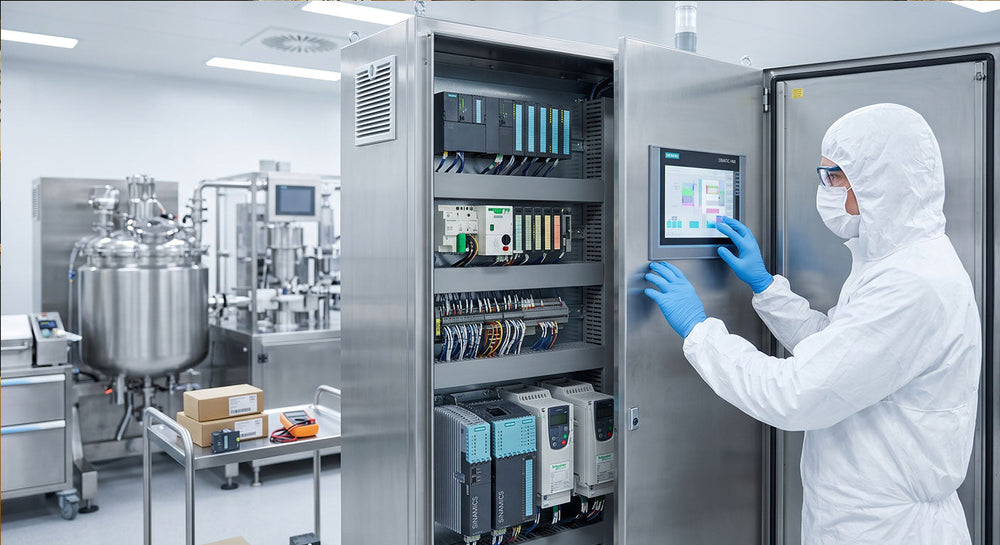
Pharmaceutical manufacturing operates under a compliance burden that has no equivalent in most other industries. Every process step, from API synthesis to final packaging, is conducted in accordance with FDA validation requirements, 21 CFR Part 11 electronic records rules, and cGMP standards governing how equipment is qualified, documented, and changed. When automation parts in pharmaceutical manufacturing fails or reaches the end of life in this environment, the sourcing decision is not just a procurement question. It is a validation question, a timeline question, and in some facilities, a regulatory risk question.
A structured spare parts strategy for industrial automation is what separates facilities that manage these risks proactively from those that scramble to source components under shutdown pressure. This blog examines how pharmaceutical and life sciences manufacturers can approach automation hardware sourcing, covering the specific equipment categories at stake, the challenges posed by obsolete and discontinued components, and how independent supplier surplus automation hardware fits into a compliant, operationally sound sourcing approach.
Why Does Automation Hardware Failure Carry Higher Stakes in Pharma?
Automation hardware failure in pharmaceutical manufacturing carries higher stakes because unplanned downtime not only affects production output. It can affect batch integrity, regulatory standing, and product release timelines. A failed PLC on a filling line or a malfunctioning VFD on an HVAC system serving a classified cleanroom can trigger environmental excursions, hold batches pending investigation, or require revalidation of the affected system before production resumes.
Unlike general manufacturing, pharma facilities operate under change control procedures that govern what equipment can be swapped in and how it must be documented. Replacing a failed automation component with an equivalent unit requires documented qualification, and in many cases, a change control record. This means sourcing speed matters: the faster a maintenance team can get a verified, compatible replacement into the qualification process, the shorter the disruption window.
Legacy hardware complicates this further. Many pharmaceutical facilities run automation platforms installed during major capital projects in the 1990s and 2000s. Those systems were validated at installation, and replacing them with current-generation hardware requires full revalidation, a project measured in months and significant capital expenditure. Extending the life of installed equipment with verified replacement hardware is often the rational choice.
What Automation Hardware Categories Are Critical in Pharmaceutical Manufacturing?
The automation hardware categories most critical in pharmaceutical manufacturing span the full control and drive stack, not just PLCs.
Programmable Logic Controllers and PACs
These govern batch sequencing, process interlocks, and equipment coordination across filling, blending, granulation, and packaging lines. In legacy pharma environments, installed PLC platforms from Siemens (SIMATIC S7-300, S7-400), Schneider Electric (Modicon Quantum, Modicon Premium), and Omron (CJ Series) remain in active service at facilities that have not yet undergone full automation modernization. Sourcing verified replacement hardware for these platforms is an active need.
Variable Frequency Drives
These control pump speed, mixer agitation rates, and HVAC system airflow across classified cleanroom environments. VFD failure in a cleanroom HVAC application can disrupt differential pressure maintenance and trigger an environmental excursion. Siemens SINAMICS drives, Schneider Electric Altivar series (ATV61 for HVAC and pump applications, ATV71 for high-power process loads), and ABB ACS series drives are common in pharma process environments.
HMI and Operator Interface Hardware
These handles batch recipe management, process parameter display, and 21 CFR Part 11-relevant operator interaction records. Siemens SIMATIC HMI panels, Schneider Electric Magelis/Harmony operator stations, and Mitsubishi Electric GOT2000 series are deployed across pharma lines. Replacing HMI hardware in a validated system requires careful verification that the firmware version is compatible with the validated configuration, making refurbished HMI hardware for life sciences applications a practical option when sourcing from the same product family and generation
Process Instrumentation
These, including temperature transmitters, pressure sensors, and flow measurement devices, feed critical process parameters into batch records. Siemens SITRANS instrumentation is widely deployed in pharmaceutical process environments for exactly these applications.
I/O Modules and Communication Hardware
These connect field instruments to control systems. In distributed pharma automation architectures, I/O modules from Siemens ET 200SP distributed I/O, Omron NX Series I/O, and Schneider Electric Modicon I/O platforms handle the field interface layer. Sourcing individual I/O modules to replace failed cards without triggering a full system replacement is a common maintenance scenario.
How Should Pharmaceutical Facilities Build a Spare Parts Strategy for Industrial Automation?
A spare parts strategy for automation parts in pharmaceutical manufacturing should be built around three variables: equipment criticality, component obsolescence risk, and validation impact.
Criticality classification identifies which automation components, if they fail, directly halt production or create a regulatory risk. Not all hardware carries equal downtime consequences:
-
A PLC CPU governing a sterile filling line is a Tier 1 asset where failure stops production and may trigger a batch investigation.
-
An I/O module on a secondary utility system carries a lower immediate risk profile.
-
Critical spares for Tier 1 equipment should be held on-site or with rapid sourcing access to minimize the qualification window.
Obsolescence mapping identifies which installed platforms are approaching or past end-of-life support from the original manufacturer. Siemens has published end-of-support timelines for the S7-300 and S7-400 families, and Schneider Electric's Modicon Premium and Quantum platforms are similarly legacy-status. Facilities that map their installed base against known EOL dates and build a sourcing plan ahead of that curve avoid emergency sourcing scenarios.
Validation impact assessment determines whether a replacement component can be qualified as equivalent to the installed unit or requires a formal change control event and revalidation. Sourcing a unit from the same product family and generation, even as surplus sealed or refurbished stock, typically supports an equivalence argument that simplifies the qualification path relative to migrating to an entirely new platform.
What Is the Role of Independent Supplier Surplus Automation Hardware in Pharma Sourcing?
Independent supplier surplus automation hardware fills the sourcing gap that standard OEM distribution cannot reliably cover for legacy and obsolete components. When a Siemens S7-400 CPU or a Schneider Electric Modicon Quantum rack component is no longer actively stocked through standard channels, independent suppliers maintaining surplus sealed and refurbished inventory become the practical option for facilities that need verified hardware without committing to a full platform migration.
For pharmaceutical procurement teams, working with an independent supplier requires the same due diligence applied to any hardware source:
-
Confirming component condition grade is surplus sealed, refurbished, or used
-
Requesting documentation of warranty coverage
-
Verifying part number accuracy against the installed system configuration
Independent supplier surplus automation hardware does not carry manufacturer authorization, but it does offer access to hardware that authorized channels may no longer support. PLC Direct supplies surplus sealed, refurbished, and used hardware across Siemens SIMATIC and SINAMICS, Schneider Electric Modicon and Altivar, Omron Sysmac and CJ Series, and Mitsubishi Electric MELSEC families, all with a 1-year PLC Direct warranty. PLC Direct does not provide programming, validation support, or integration services. The focus is on hardware supply for maintenance and lifecycle continuity.
How Does Obsolete PLC Parts Sourcing Work for Legacy Pharma Systems?
Obsolete PLC parts sourcing for legacy pharma systems typically begins when a standard procurement channel returns no stock, long lead times, or a discontinuation notice. At that point, procurement and maintenance teams move to independent suppliers who stock surplus PLC hardware for pharma facilities outside standard OEM distribution channels.
Two variables determine whether that sourcing effort succeeds:
-
Part number precision: Pharmaceutical systems often run validated firmware versions tied to specific hardware revisions. Sourcing a compatible replacement requires attention to revision letters and hardware suffixes, not just base part numbers.
-
Condition verification: Surplus sealed units are factory-sealed stock that has not been placed into service. Refurbished units have been tested and restored to operational functionality. Both grades carry a 1-year PLC Direct warranty and are preferable to unverified used stock for validated system applications.
Reputable independent suppliers will work with procurement teams to cross-reference part numbers and confirm hardware condition before order placement.
Conclusion
Pharmaceutical manufacturing has little tolerance for sourcing delays. When a validated system goes down, the clock is running on batch records, environmental monitoring, and production commitments simultaneously. Having a spare parts strategy in place before that happens, and knowing which independent suppliers carry the hardware your installed systems actually need, is the practical version of risk management for maintenance and procurement teams in this industry. Contact us to confirm availability on specific part numbers.
