
 1 year warranty

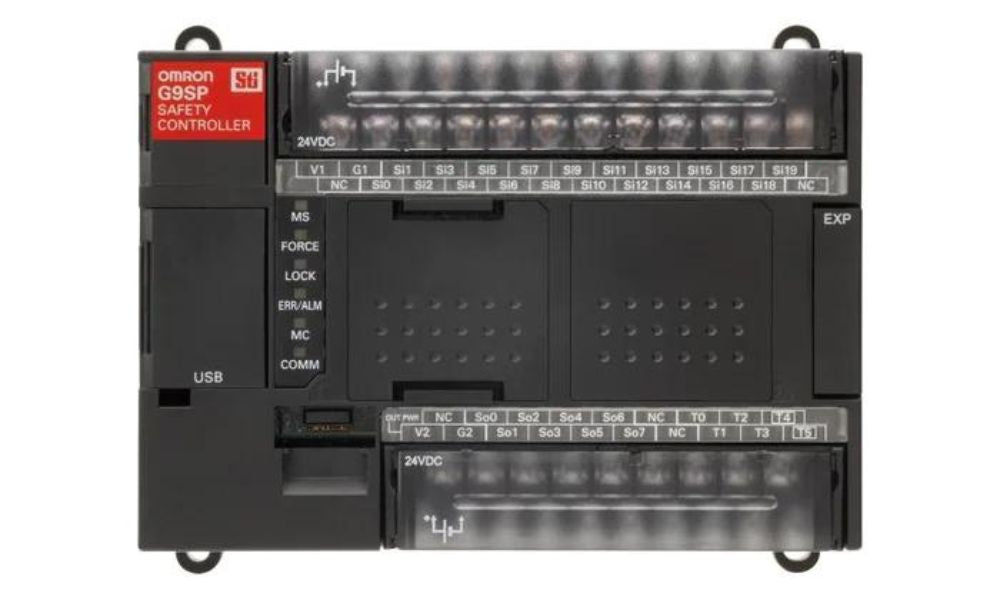
The safety of your employees is among your top priorities as a business owner. As such, you need a reliable safety system in your industrial plant to help minimize risks. A programmable logic controller (PLC) that guarantees the safety of your employees and equipment is a necessity. Omron is one of the most established brands in industrial safety automation, and its safety products are both versatile and reliable. This guide compares Omron safety PLCs with other brands across key evaluation criteria to help maintenance engineers and procurement teams make informed sourcing decisions.
What Is a Safety PLC and How Does It Differ From a Standard PLC?
A safety PLC is a controller specifically designed and certified to perform safety-related functions in industrial environments. It operates in accordance with recognized functional safety standards such as IEC 62061 (SIL) and ISO 13849 (PL). A standard PLC handles general automation logic but does not meet the diagnostic coverage, redundancy, and response time requirements necessary for safety-rated applications.
The key technical distinctions between a safety PLC and a standard PLC include:
-
Redundant CPU architecture: Safety PLCs use dual-channel processing with cross-checking to detect faults before they result in a dangerous output state.
-
Diagnostic coverage: Safety-rated hardware detects and responds to internal faults, including stuck outputs, short circuits, and communication failures, within defined diagnostic intervals.
-
Certified safety I/O: Safety PLCs require dedicated safety-rated input and output modules that monitor signal integrity and detect discrepancies between redundant channels.
-
Functional safety standards compliance: Safety PLCs are independently certified to SIL 2 or SIL 3 (IEC 62061) and PLd or PLe (ISO 13849).
A standard PLC cannot substitute for a certified safety PLC in applications where these ratings are required by machinery directive, risk assessment, or industry regulation.
How Do Omron Safety PLCs Perform in Terms of General Functionality?
Omron safety PLCs have a reputation for their outstanding functionality. They offer a wide range of functions for various applications. The brand's safety controllers feature emergency-stop and guard-locking switches, ensuring your machinery and equipment stop when necessary to prevent accidents. Omron safety PLCs also offer a diverse range of safety I/O modules, allowing connection to multiple safety sensors.
The NX series safety platform confirmed in PLC Direct's inventory includes:
-
NX-SL3300: Safety network controller supporting 32 safety master connections and up to 256 safety I/O points.
-
NX-SL5500: Safety PLC CPU with 2MB program memory and capacity for up to 1,024 safety points.
-
NX-SIH400: Safety input module, 4 digital safety inputs, PNP 24VDC, screwless push-in connector.
-
NX-SID800: Safety input module, 8 digital safety inputs, standard connectivity.
-
NX-SOD400: Safety output module, 4 outputs at 0.5A.
Omron safety PLCs have the necessary certifications to meet various industrial safety standards, such as SIL3 (IEC 62061) and PLe (ISO 13849). Omron also ensures its products pass rigorous safety tests before releasing them to the market.
Other brands offering safety PLCs may have different feature sets and programming environments. Some platforms require greater programming proficiency, whereas Omron safety PLCs are known for their user-friendly interfaces and straightforward configuration in the Sysmac Studio environment.
How Do Brand Offerings Compare When Assessing Safety I/O Support Among PLC Brands?
When assessing safety I/O support among safety PLC manufacturers, the key differentiators are I/O density, openness to safety protocols, integration with the standard control platform, and certification architecture.
Among safety PLC manufacturers, the major platforms in industrial use include Omron's Sysmac NX safety series, Siemens SIMATIC Safety, Schneider Electric Modicon M580 Safety, ABB AC500-S, and Pilz PNOZmulti. A structured comparison across key criteria:
-
Safety I/O scalability: Omron's NX safety platform scales from compact modules such as the NX-SIH400 (4 inputs) to high-density controllers such as the NX-SL5500 (1,024 safety points). Siemens SIMATIC Safety and Schneider Modicon M580 Safety offer comparable scalability within their rack-based architectures.
-
Integration with standard control: Omron's Sysmac NX platform integrates safety and standard I/O on the same backplane with a unified programming environment. Siemens SIMATIC Safety similarly integrates safety functions within TIA Portal.
-
Certification levels: SIL3/PLe certification is available across major safety PLC manufacturers, including Omron, Siemens, Schneider, and ABB. Architecture, I/O density, and integration flexibility are the practical distinguishing factors at this level.
-
Cross-brand compatibility: Omron's NX safety I/O communicates over FSoE (Functional Safety over EtherCAT), an open safety protocol. This allows NX safety I/O to interface with safety controllers from other manufacturers that support FSoE.
How Flexible Are Omron Safety PLCs Across Different Industry Applications?
The flexibility of Omron safety PLCs is apparent in their product line. Omron safety PLCs range from compact models to advanced models, making them suitable for all industries, including automotive, pharmaceutical, and aerospace. The brand’s control products feature advanced machine safety features, including some models with safe-torque-off functions. These functionalities ensure that machinery and other equipment stop safely in emergencies.
Safety PLCs from other brands often work best with their own products, making it more complex to integrate safety systems into equipment from other manufacturers. In contrast, Omron's NX safety I/O uses the open FSoE protocol, which supports integration with other brands' safety systems and provides greater flexibility in mixed-brand installations.
How Should Facilities Evaluate Safety PLC Options for Their Application?
Evaluating safety PLC options starts with the risk assessment output and the required SIL or PL rating for each safety function, then works backward to identify hardware that meets those requirements within the existing automation architecture.
The practical evaluation criteria for safety PLC selection are:
-
Required safety integrity level: The risk assessment defines the minimum SIL or PL required. Most major safety PLC manufacturers support SIL2/PLd and SIL3/PLe.
-
I/O requirements: The number and type of safety inputs and outputs determine whether a compact safety relay, a modular safety controller, or a full safety PLC CPU is the appropriate hardware tier.
-
Integration with the installed automation platform: Facilities running Omron Sysmac NX standard controllers benefit from integrating Omron NX safety I/O on the same platform. Facilities running Siemens SIMATIC or Schneider Modicon installations may find tighter integration with their respective safety platforms.
-
Lifecycle and parts availability: For facilities maintaining existing safety PLC installations, parts availability through independent suppliers is a practical consideration. PLC Direct stocks Omron NX series safety hardware, including NX-SL3300, NX-SL5500, NX-SIH400, NX-SID800, and NX-SOD400 as surplus sealed, refurbished, and used stock, all with a 1-year PLC Direct warranty.
For procurement teams and maintenance engineers sourcing Omron safety PLC hardware, contact PLC Direct to check current availability.
