
 1 year warranty

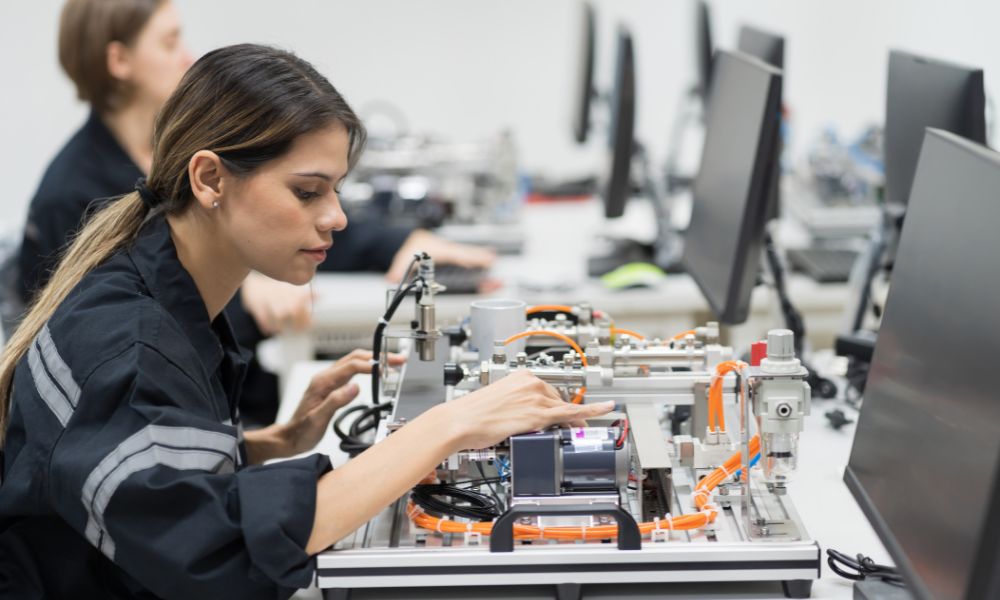
In industrial automation control systems, selecting the right control technology for a given application is one of the most consequential decisions a facility makes. Two of the most widely deployed control technologies are Computer Numerical Control (CNC) and Programmable Logic Controller (PLC) systems. While both automate machine and process operations, they are built for fundamentally different applications and operate on different control architectures.
Understanding the CNC vs PLC distinction helps procurement managers and maintenance engineers specify the right hardware for new installations, evaluate existing control infrastructure, and make informed sourcing decisions when replacement hardware is needed.
What Is a CNC System and What Does It Control?
A CNC system uses computer numerical control software to direct the precise movement of machine tools along programmed axes. CNC software translates a part program, typically written in G-code, into coordinated motion commands that drive spindles, cutting tools, and workpiece positioning systems with high dimensional accuracy.
CNC systems are designed for applications where the primary requirement is geometric precision in machining. Key characteristics include:
-
High Precision: CNC software enables precise control of machine-tool movements, producing consistent dimensional accuracy across production runs and minimizing material waste
-
Flexibility: CNC machines are quickly reprogrammable, making them suitable for small-batch or customized production runs where part geometry changes frequently
-
Reduced Operator Input: Machines operate autonomously once programmed, freeing operators to focus on setup, quality checks, and other tasks
CNC systems are the standard control technology for milling machines, lathes, grinding machines, EDM equipment, and multi-axis machining centers. They are not designed for general process control, field device sequencing, or real-time management of electromechanical systems outside the machine tool environment.
What Is PLC Software and What Does It Control?
PLC software is the programming environment used to create and execute control logic on a programmable logic controller. Unlike CNC, which executes a linear part program to achieve a geometric output, PLC software implements ladder logic, function block diagrams, structured text, or other IEC 61131-3 languages to manage the state-based, event-driven control of industrial processes and equipment.
PLC software running on industrial automation control systems manages inputs from sensors, switches, and instruments, and drives outputs to motors, valves, conveyors, and actuators based on programmed logic conditions. Key characteristics include:
-
Robust and Reliable: PLCs withstand continuous operation in harsh industrial environments, with resistance to dust, temperature extremes, and vibration built into the hardware design.
-
Real-time Control: PLC software provides deterministic, real-time control of electromechanical processes, including conveyor belts, motors, pumps, and valves.
-
Easy Integration: PLC programs integrate with existing I/O devices, sensors, and network protocols, including Modbus, PROFIBUS, EtherNet/IP, and PROFINET, enabling communication across complex automation architectures.
PLC software is the control layer of choice for assembly lines, material handling systems, conveyor networks, packaging equipment, process plant automation, and warehouse control systems. It is designed for continuous, cyclic execution rather than the linear, program-complete execution model of CNC.
What Are the Core Differences Between CNC vs PLC Systems?
The CNC vs PLC distinction comes down to application type, control architecture, and programming model.
CNC systems are optimized for precision motion control in machine tool applications. The control objective is geometric accuracy: producing a part to a defined dimensional specification by coordinating multi-axis motion. CNC systems execute a part program from start to finish and then wait for the next program to be loaded.
PLC systems are optimized for process and equipment control across industrial environments. The control objective is reliable state management: ensuring that the right outputs are active based on the current state of inputs, interlocks, and process conditions. PLC software runs in a continuous scan cycle, reading inputs and updating outputs in real time regardless of the process's stage.
In practice, CNC and PLC systems often operate alongside each other within the same facility. A CNC machining center produces parts to specification, while a PLC-controlled conveyor system manages the movement of raw material to the machine and finished parts away from it. The two technologies complement rather than compete with each other in most manufacturing environments.
How Do You Choose Between CNC and PLC for Your Application?
Selecting the right control technology starts with defining what the application needs to control and the primary performance requirement.
|
Choose CNC if: |
Choose PLC if: |
|
The application involves machine tool operations requiring precise multi-axis motion.
|
The application involves sequencing, interlocking, or real-time control of process equipment. |
|
Part geometry changes frequently, and rapid reprogramming between runs is required. |
The system needs to manage multiple field devices across a conveyor, assembly, or process line. |
|
The control objective is dimensional accuracy of a machined or cut output/ |
Integration with sensors, drives, HMIs, and supervisory systems is required. |
For facilities running industrial automation control systems that include both manufacturing and material handling operations, CNC and PLC hardware will typically both be present, serving their respective control roles within the same production environment.
What PLC Hardware Platforms Are Used in Industrial Automation Control Systems?
PLC software runs on controller hardware from a range of manufacturers, each offering platforms suited to different application scales and industry requirements. Commonly deployed platforms in industrial automation control systems include:
-
Siemens SIMATIC S7-1200 and S7-300/400: Widely used across manufacturing, process, and material handling applications
-
Schneider Electric Modicon M340 and M580: Deployed in mid-range to high-end process and machine control
-
Mitsubishi Electric MELSEC Q Series and iQ-R: Common in discrete manufacturing and conveyor automation
-
Omron Sysmac NX and CJ Series: Used in packaging, assembly, and machine control applications
PLC Direct stocks surplus sealed, refurbished, and used PLC hardware across these platforms, along with associated I/O modules, VFDs, and HMIs. All hardware carries a 1-year PLC Direct warranty across all condition grades.
In Conclusion
Selecting the right control technology and sourcing the hardware to support it directly affects how reliably an industrial automation system performs over its operational life. PLC Direct supplies surplus sealed, refurbished, and used PLC hardware and automation components across leading platforms to support both new installations and installed-base maintenance. To check availability on specific part numbers or request a quote, get in touch with PLC Direct.
