
 1 year warranty

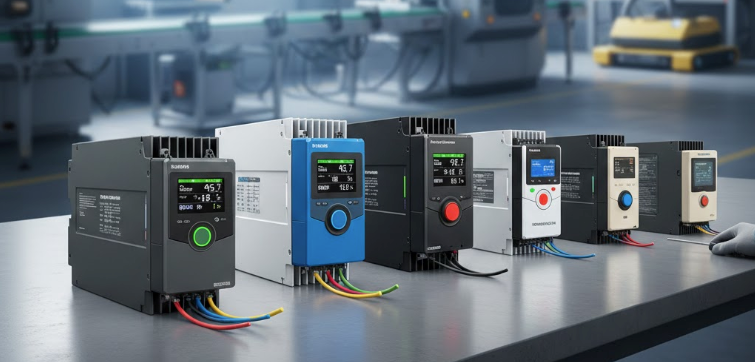
In industrial and building automation environments, electric motors drive the majority of mechanical processes: pumps, fans, conveyors, compressors, mixers, and machine tools. Most of these motors are AC induction motors, which, without additional control hardware, run at a fixed speed determined by the supply frequency. An AC drive changes that by giving operators and control systems precise authority over motor speed and torque.
Understanding what an AC drive is, how it works, and where it applies is foundational knowledge for any maintenance engineer or procurement manager specifying or sourcing VFD motor control hardware.
What Is an AC Drive?
An AC drive is an electronic device that controls the speed and torque of an AC motor by adjusting the frequency and voltage of the electrical power supplied to it. Also commonly called a variable frequency drive, or VFD, the AC drive allows a motor to operate across a continuous range of speeds rather than at a single fixed speed dictated by the mains frequency.
This capability is fundamental to modern industrial automation. A pump running at full speed continuously consumes full power regardless of whether full flow is needed. The same pump controlled by a variable frequency drive runs only as fast as the process demands, which reduces energy consumption, mechanical wear, and noise across the operating range.
How Does an AC Drive Work?
The internal operation of an AC drive follows three sequential stages:
-
Rectifier: Converts incoming AC power from the mains supply into DC power
-
DC Bus: Filters and smooths the DC power to maintain a stable intermediate voltage
-
Inverter: Converts the DC power back into AC power at the frequency and voltage required to achieve the target motor speed
The inverter stage uses pulse-width modulation (PWM) to synthesize an AC output waveform at the desired frequency. By varying the output frequency, the drive controls the motor's rotational speed. By varying the output voltage in proportion to the frequency, it maintains the correct voltage-to-frequency ratio, keeping motor flux and torque stable across the speed range.
This three-stage process enables VFD motor control to deliver smooth acceleration, controlled deceleration, and precise speed regulation without the mechanical stress of direct-on-line starting.
Why Use an AC Drive in Industrial Applications?
AC drives deliver measurable operational benefits across a range of applications:
-
Energy Savings: Matching motor speed to actual process demand rather than running at full speed continuously reduces power consumption significantly, particularly in pump and fan applications where power demand follows the cube of speed
-
Better Process Control: Precise speed regulation improves product consistency in applications such as mixing, filling, winding, and conveyor indexing
-
Reduced Mechanical Wear: Soft start and stop ramp profiles eliminate the mechanical shock of direct-on-line starting, reducing stress on couplings, belts, gearboxes, and driven equipment
-
Extended Equipment Life: Lower mechanical stress across start/stop cycles extends the service life of both the motor and the driven equipment
-
Flexibility: A single AC drive platform can be configured for pump control, fan control, conveyor drives, and machine tool spindles, reducing the number of distinct spare parts a facility needs to stock
Where Are AC Drives Used?
AC drives are deployed across virtually every sector of industrial and commercial automation. Common applications include:
-
Pump control in water and wastewater treatment, process industries, and HVAC systems
-
Fan and blower control in ventilation, combustion air, and cooling applications
-
Conveyor and material handling drives in manufacturing, warehousing, and mining
-
Compressor control in refrigeration, compressed air, and gas handling systems
-
Machine tool spindle drives in metalworking and woodworking applications
-
Mixer and agitator drives in food and beverage, chemical, and pharmaceutical processing
In each of these applications, VFD motor control replaces fixed-speed operation with a speed-matched drive, reducing energy consumption and improving process response.
What AC Drive Brands Does PLC Direct Carry?
PLC Direct stocks surplus sealed, refurbished, and used AC drive hardware across multiple manufacturer platforms. Confirmed brands and drive families available include:
-
Siemens SINAMICS: Siemens' variable frequency drive range covers applications from compact machine drives through high-power industrial applications. The SINAMICS S120 is deployed in multi-axis coordinated drive applications in manufacturing environments.
-
ABB ACS series: ABB's AC drive portfolio includes the ACS310 for HVAC pump and fan applications, the ACS355 for general industrial motor control with safe torque off (STO) capability, and the ACS880 industrial drive series for heavy-duty applications requiring high power and advanced motor control.
-
Schneider Electric Altivar: The Altivar 61 (ATV61) is optimized for pumping and ventilation applications; the Altivar 71 (ATV71) covers complex machine and high-power industrial drive applications.
-
Yaskawa: Yaskawa variable frequency drives are widely used in motion-intensive applications. Specific product families will be confirmed against live inventory before referencing in detail.
-
Honeywell: Honeywell drive hardware is stocked for building automation and process control applications. Product families confirmed against live inventory on request.
All AC drive hardware at PLC Direct is covered by a 1-year PLC Direct warranty across surplus, sealed, refurbished, and used condition grades.
How Do You Select the Right AC Drive for an Application?
Selecting the correct AC drive requires matching several key parameters to the application:
-
Motor Voltage and Current Rating: The drive's output voltage and current capacity must match the motor nameplate specifications.
-
Power Rating: Drive power rating in kW or HP must meet or exceed the motor's rated power.
-
Control Mode: Volts/hertz (V/f) control suits most pump and fan applications; vector control is required for applications needing precise torque or speed regulation at low speeds.
-
Communication Protocol: The drive must support the fieldbus or Ethernet protocol used by the facility's control system, whether Modbus RTU, PROFIBUS, PROFINET, or EtherNet/IP.
-
Environmental Rating: IP20 drives are suited to clean panel environments; IP54 or higher is required for dusty or wet locations.
-
Braking Requirements: Applications with high inertia loads or frequent deceleration may require a drive with a braking chopper and an external braking resistor.
For replacement applications, the simplest starting point is the installed drive's part number, which encodes the power rating, voltage class, and frame size. PLC Direct stocks AC drive hardware across multiple condition grades, giving procurement teams options when an exact replacement is needed quickly and OEM lead times are extended.
Conclusion
AC drives are a foundational component of efficient VFD motor control across industrial and building automation. PLC Direct supplies surplus sealed, refurbished, and used AC drive hardware across Siemens SINAMICS, ABB ACS series, and Schneider Electric Altivar platforms, along with associated automation components. To check availability on a specific drive part number or discuss sourcing options, contact us today.
