
 1 year warranty

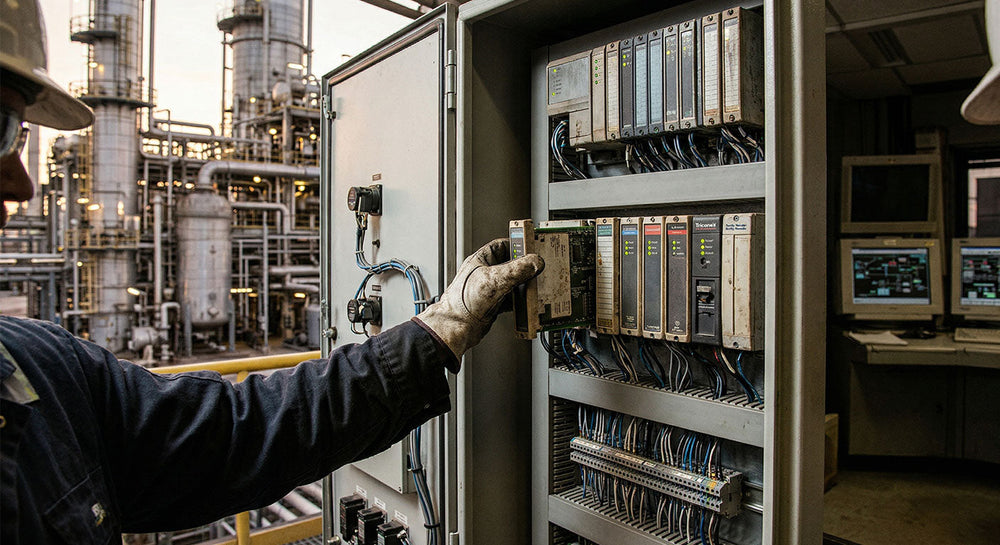
According to the U.S. Energy Information Administration, the newest U.S. refinery with significant downstream unit capacity came online in 1977. Most of the country's 132 operable refineries have been running ever since on control systems that predate current-generation platforms by decades.
When hardware on one of these aging systems fails, the OEM channel rarely has stock. PLC Direct supplies surplus DCS hardware, refurbished process control system modules, and obsolete oil and gas automation parts across the platforms most widely deployed in refining, upstream production, and petrochemical processing.
What Types of Control Hardware Are Used in Oil, Gas, and Petrochemical Plants?
Process control in these environments runs on multiple interdependent system layers, each serving a distinct function.
Distributed Control Systems (DCS)
The primary process control layer in most refineries and chemical plants. A DCS manages continuous process variables across multiple loops, handling temperature, pressure, flow, and level control across entire plant units. Common platforms include Foxboro I/A Series, Honeywell TDC 3000, and Experion PKS, ABB System 800xA, and Emerson DeltaV and Ovation.
Safety Instrumented Systems (SIS)
Architecturally independent from the DCS by design, SIS platforms execute emergency shutdown, high-integrity pressure protection, and burner management functions. These systems are SIL-rated and kept separate from the process control layer to ensure a DCS failure cannot compromise a safety function. Triconex Tricon is one of the most widely deployed SIS platforms in refining and petrochemical operations globally.
Machinery Protection and Condition Monitoring
Compressors, turbines, pumps, and fans in oil and gas operations require continuous vibration, position, and speed monitoring to detect developing faults before catastrophic failure. Bently Nevada machinery monitoring systems, including the 3300 and 3500 series, are the dominant platform in this category across process industries.
PLCs and PACs for Unit and Package Control
While DCS handles continuous process control, PLCs manage discrete functions, such as pump sequencing, valve control, compressor packages, and utility systems. Siemens SIMATIC S7 series, Schneider Electric Modicon, and ABB AC500 are widely deployed in these supporting roles.
Process Instrumentation
Transmitters, positioners, and field instruments form the measurement layer feeding the control systems. Foxboro pressure transmitters, Siemens SITRANS instrumentation, and Emerson Rosemount devices are common across refining and petrochemical applications.
Why Do Oil, Gas, and Petrochemical Facilities Run Obsolete Automation Hardware Longer Than Other Industries?
Several converging factors make the continuation of legacy systems the default in process industries.
- Continuous operation: Refineries and petrochemical plants rarely stop. Turnarounds, the planned shutdowns during which major maintenance and upgrades occur, happen on cycles of three to five years or longer. Outside of a turnaround window, replacing a DCS controller or SIS module requires either a live cutover in a hazardous process environment or deferral to the next scheduled shutdown.
- Validation and regulatory burden: Safety instrumented systems carry SIL certification tied to the specific hardware configuration. Changing that hardware, even to a current-generation equivalent, requires revalidation of the safety function under IEC 61511. That process takes time and engineering resources, reinforcing the preference for maintaining the installed platform.
- Capital allocation cycles: A full DCS migration at a refinery is a multi-million-dollar capital project. For a facility running within acceptable parameters, that investment competes against other capital priorities and frequently loses. The operational decision defaults to maintaining the existing system with replacement parts.
- Engineering knowledge tied to the installed platform: Operations and maintenance teams build deep familiarity with an installed control system over years of use. Migrating to a new platform requires retraining, new tooling, and a transition period during which institutional knowledge for the new system does not yet exist.
The combined effect is that platforms with commercial end-of-life dates years in the past remain in active, continuous service. Honeywell TDC 3000, Foxboro I/A Series, and Triconex Tricon installations from the 1990s and early 2000s are not unusual finds in operating facilities today.
What Should Maintenance Teams Verify Before Sourcing Surplus DCS Hardware?
Sourcing surplus DCS hardware or a refurbished process control system module for an active installation requires more careful verification than a standard automation part purchase.
Before placing an order:
- DCS modules are often revision-specific. A module from a different hardware revision may not be compatible with the installed system's backplane or firmware. Confirm the full part number, including any revision suffix.
- For DCS I/O modules, confirm the module type, channel count, and signal type match the installed baseplate and controller firmware version.
- For Triconex or other SIS modules, the replacement unit must match the installed module exactly. Any deviation from the validated hardware configuration must be reviewed under the facility's management of change procedures before installation.
- Surplus sealed modules have never been in service. Refurbished modules have been inspected, tested, and restored to operational specification. Confirm the condition grade with the supplier before ordering.
- Confirm the supplier backs the hardware with a warranty covering defects and functionality.
Which DCS and Process Control Brands Does PLC Direct Carry?
PLC Direct stocks surplus DCS hardware and obsolete oil and gas automation parts across the platforms most commonly deployed in refining, upstream production, and petrochemical processing.
Foxboro I/A Series
The Foxboro I/A Series is one of the most widely installed DCS platforms in the refining and chemical processing industries. PLC Direct carries confirmed Foxboro I/A Series FBM fieldbus modules for oil and gas, refining, chemical, and power generation applications. Foxboro process instrumentation is also confirmed, including the IDP10 Intelligent Differential Pressure Transmitter with HART 7 and Foundation Fieldbus communication and SIL 2/3 certification, and 761 Series single-loop process controllers with PID control, auto-tuning, and serial communication.
Honeywell Process Control
Honeywell TDC 3000 and Experion PKS are among the longest-running DCS architectures in refining and petrochemical operations. Honeywell process control hardware is confirmed in the PLC Direct collection, including UCN Series serial interface processors and process manager components for the TDC 3000 platform.
Triconex Tricon Safety Systems
Triconex Tricon is confirmed in the PLC Direct collection with extensive platform coverage. Confirmed hardware includes main chassis variants (8100-1, 8101, 8105, 8110, 8112, 8120E, 8120X), expansion chassis (8111), power supply modules (8300A, 8301A), and communication modules covering integration with Honeywell TDC 3000, Honeywell Experion PKS, and Foxboro I/A Series. The 4409 Safety Manager Module and multiple digital output and communication modules are also confirmed.
Bently Nevada Machinery Monitoring
Bently Nevada 3300 series hardware is confirmed in the PLC Direct collection, including 3300 XL proximity sensors (330901), system modules (3300/50, 3300/80), and condition monitoring components for continuous online vibration, position, temperature, and speed monitoring of rotating equipment in oil and gas, petrochemical, and power generation applications.
Siemens SIMATIC and SIPLUS
Siemens SIMATIC S7-300 and S7-400 are confirmed in the PLC Direct collection for unit- and package-control applications. Siemens SIPLUS, the extreme-condition variant of the SIMATIC platform, is also confirmed and is commonly specified in upstream oil and gas applications where ambient temperature and humidity exceed standard industrial ratings.
ABB AC500 and System 800xA
ABB AC500 PLC hardware is confirmed in the PLC Direct collection for unit and package control. ABB System 800xA, the distributed control system widely deployed in oil and gas and petrochemical processing, is supported through ABB's broader automation hardware collection on PLC Direct.
Emerson and Schneider Electric Modicon Quantum
Emerson process control and instrumentation hardware, including DeltaV components, is confirmed in the PLC Direct Emerson collection. Schneider Electric Modicon Quantum, widely deployed in refining and petrochemical applications, is confirmed to support the 140CPU series hardware in the PLC Direct collection.
When Does Sourcing Surplus or Refurbished Process Control Hardware Make Sense?
A module failure on an active DCS or SIS in a running plant creates immediate pressure. The OEM channel for legacy process control hardware often cannot respond at the speed required, particularly for platforms no longer in active production.
Sourcing surplus DCS hardware, a refurbished process control system component, or obsolete oil gas automation parts, from an independent supplier directly addresses the lead-time problem. For facilities in turnaround preparation, building a surplus sealed spare pool before the shutdown window reduces the risk of parts unavailability, delaying the work.
All hardware purchased from PLC Direct carries a 1-year PLC Direct warranty covering defects and functionality. Contact us to check availability on specific part numbers.
